- 0
- 2,550 words
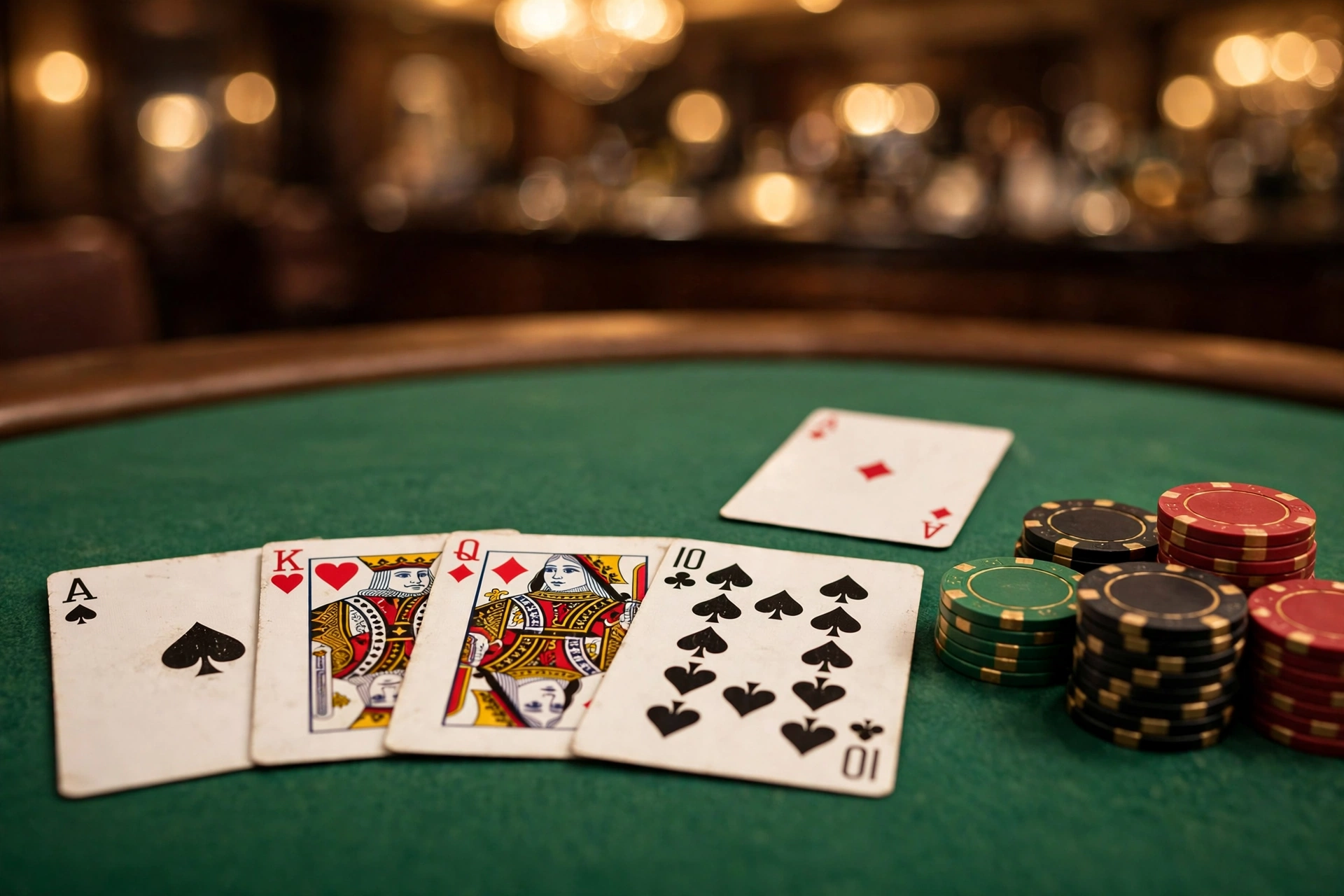
The first time I sat down at a Caribbean Stud table, I treated it like real poker. I tried to read the other players and played tight-aggressive like I’d seen on TV — then got confused when nobody bluffed and the dealer never folded. If you’re wondering how to play caribbean stud poker for beginners, here’s the first thing to understand: this isn’t really poker in the sense you’re picturing. You’re not playing against other people. You play one five-card hand against the dealer, and the only real decision is whether your hand is worth doubling down on.
The second thing I learned about how to play caribbean stud poker for beginners is that the game is quietly brilliant at taking your money while making you feel smart. One decision per hand — what could go wrong? But the rules have teeth: a dealer qualifier, payouts that pay less than you think, and a side bet dangling a life-changing jackpot. This guide is the walkthrough I wish I’d had: the math, the strategy, and my mistakes, so you don’t repeat them.
Table of Contents
How to Play Caribbean Stud Poker for Beginners: The Simple Version
Here’s the whole game in about thirty seconds, before we get into the weeds. You place an ante bet. You get five cards; the dealer gets five, but you see one of theirs. You look at your hand and make one decision: fold (lose your ante) or raise (bet exactly twice your ante). Then the dealer reveals. The dealer’s hand must be at least ace-king high — the “qualifier” — for the hand to play out. Beat a qualifying dealer hand, and you get paid per the payout table.
That’s it. No drawing cards, no bluffing, no betting rounds — one decision per hand. That simplicity is the appeal, and, as we’ll see, part of the danger. But I’m getting ahead of myself. Let’s go piece by piece.
What Caribbean Stud Actually Is (and How It Differs From Other Poker Games)
Caribbean Stud is called a “poker” game and uses poker hand rankings — but the structure is nothing like the poker you’re picturing. No betting against other players, no pot, no bluffing, no tells, no all-ins. The other players at the table are irrelevant to your hand.
What it actually is: a casino table game where you play a fixed five-card hand against the house, with a fixed decision point and a fixed payout table. It’s closer to blackjack than to poker — you’re playing the dealer’s hand, not outthinking humans. Your only job is to play each hand correctly.
This matters because poker players sometimes walk in thinking their skills transfer. They don’t. Reading people is useless here; aggression is useless here. What transfers is knowing the hand rankings and having the discipline to fold weak hands. I played my first session like a tournament, raising marginal hands on “poker instinct” — the classic rookie error when learning how to play caribbean stud poker for beginners — and it cost me real money before the hour was out.
The Ante and the Optional Progressive Jackpot Side Bet
Every hand starts with an ante bet — your entry fee, typically $5 to $25 depending on the casino. The ante is what you forfeit if you fold.
Then there’s the progressive jackpot side bet: usually $1 in a separate spot, for a shot at a jackpot meter that grows until someone hits it. Typically a royal flush wins the whole thing, with smaller fixed prizes for a straight flush, four of a kind, full house, and flush.
Here’s my honest take: the side bet is a lottery ticket, not a strategy. The house edge is enormous — well over 20% in most estimates — and a royal flush is astronomically unlikely. I still play it sometimes, because a dollar for a dream is cheap entertainment. But treat it as exactly that: a $1 donation to your fun, not part of your strategy. On a tight bankroll, skip it.
How the Deal Works: Five Cards Each, One Dealer Card Face Up
Once bets are placed, the dealer deals five cards to each player face down, and five to themselves — four down, one up. That single face-up dealer card is the most important information you’ll get all hand: your only window into the dealer’s strength.
Take your cards and look at them. That’s your whole universe of information: your five cards plus one dealer upcard. From that, you fold or raise. You can’t swap or draw — what you’re dealt is what you play.
One table rule worth knowing: don’t discuss or show your hand to other players. Sharing information about folded cards could give players an edge by revealing which cards are dead, so casinos ban it. Keep your cards to yourself, make your decision, and move on.
The Only Decision You’ll Make: Fold or Raise
This is the heart of the game, and learning how to play caribbean stud poker for beginners really comes down to getting this one decision right consistently. After looking at your cards and the dealer’s upcard, you choose:
- Fold: You forfeit your ante and the hand is over. Your cards are done.
- Raise: You place a bet of exactly twice your ante (no more, no less) next to your ante, and the hand plays out against the dealer’s hand.
No calling, no checking, no third option — you walk away or you double your exposure. Your risk per hand is always either 1x the ante (fold) or 3x total (ante plus the 2x raise). That fixed structure is why folding discipline matters: every lazy raise on a garbage hand costs you exactly 2x your ante.
If you’re coming from other casino card games, one binary decision will feel strange at first. Our three card poker guide covers a game with the same one-decision DNA — same family, same discipline: fold the weak stuff, don’t get emotional about money already bet.
The Dealer Qualifier: Ace-King or Better
Here’s the rule that trips up every beginner learning how to play caribbean stud poker for beginners, and the one the dealer will explain quickly while you nod and pretend you understood: the dealer’s hand must “qualify” — it needs to be at least ace-king high — for the hand to play out. Anything weaker, and the hand doesn’t count as a contest.
The casino doesn’t want to pay you for beating a dealer’s pile of nothing, so ace-king high is the line in the sand — no pair needed, just the high cards.
Why does this rule exist? Because it quietly improves the house’s position. The dealer’s weak hands — the ones you’d love to beat — get voided instead of paying you. It’s the single biggest structural reason the game favors the house, and it’s why your fold/raise decision has to account for the fact that some winning hands only pay even money on the ante.
What Happens When the Dealer Doesn’t Qualify
So the dealer flips and the hand is weaker than ace-king high — say, king-queen-ten high. Here’s what happens:
- If you folded: nothing changes. Your ante was already gone when you folded.
- If you raised: you don’t win — but you don’t lose your raise either. You get the raise back (a push), and your ante is paid at 1:1. On a $10 ante with a $20 raise, that means $30 back plus $10 profit.
Notice what’s happening: your raise is refunded and you win only even money on the ante. You risked $30 total to walk away with $10 profit — nice, but a fraction of what a qualifying dealer would have paid.
This is the rule beginners misunderstand most. I once watched a guy celebrate a two-pair win against a non-qualifying dealer, confused when he was paid a fraction of the payout table. The payout table only applies when the dealer qualifies — otherwise it’s just even money on the ante plus your raise back. Burn this into memory: it’s the biggest source of confusion for anyone learning how to play caribbean stud poker for beginners.
Caribbean Stud Payout Table Basics
When the dealer qualifies and your hand beats theirs, you win: the ante pays 1:1, and the raise is paid according to the payout table — which is where the game gets exciting. The standard payouts on the raise (expressed as “X to 1” on the raise amount) look roughly like this:
- Royal flush: 100 to 1
- Straight flush: 50 to 1
- Four of a kind: 20 to 1
- Full house: 7 to 1
- Flush: 5 to 1
- Straight: 4 to 1
- Three of a kind: 3 to 1
- Two pair: 2 to 1
- One pair or less: 1 to 1
Payout tables vary slightly by casino, so confirm the rules where you play. The key insight: only strong hands get the big multipliers, and the ante always pays just 1:1. So even when you win, a chunk of your money sits in the ante slot getting paid even money — that’s the structural drag.
For a second source on hand rankings and payouts, this detailed Caribbean Stud guide is worth a cross-check before you sit down.
A Simple Beginner Strategy and the 5.2% House Edge Reality
Okay, the part you’ve been waiting for: what should you actually do with your hand? The beginner strategy that gets you most of the way there is simple:
- Raise if you have a pair or better. Always.
- Raise if you have ace-king high. Always.
- Exception: fold ace-king when the dealer’s upcard is an ace or king and you don’t hold one of them.
- Fold everything weaker than ace-king. Yes, really. Jack-ten high? Fold. King-queen high? Fold.
The full optimal strategy adds a little nuance around matching the dealer’s upcard, but the version above plays within a fraction of a percent of optimal. The critical habit is folding hands weaker than ace-king. It will feel wrong — you’ll fold king-high, watch the dealer flip a non-qualifying hand, and think “I would have won!” — but the math says fold.
Now the honest part: the house edge is roughly 5.2% with perfect strategy — ten times the 0.5% of basic-strategy blackjack. The big payout multipliers and the progressive dream are paid for by a bigger cut on every hand.
What does 5.2% mean in practice? Over a long stretch, for every $100 you put through the game, expect to lose about $5.20. Short sessions can go either way — variance is huge because of the top-heavy payouts — but the longer you play, the closer your results get to that number. I say this because how to play caribbean stud poker for beginners has to include the truth: this is a high-edge game to play for entertainment with money you can afford to lose, not a way to make money.
Online vs Live-Dealer Play, Bankroll Tips, and My Final Take
Where should a beginner actually play? Live casino tables give you the full experience — real cards, real dealer, the progressive meter above you — but minimums are higher and the pace punishes beginners who haven’t learned the rules yet. Online Caribbean Stud (the digital table-game version) lets you play $1 hands with no dealer waiting and no table pressure. For learning the game, online at minimum stakes is the clear winner — that’s where I’d send anyone learning how to play caribbean stud poker for beginners.
Bankroll tips, learned the hard way:
- Set a session bankroll and bring only that. When it’s gone, you’re done — the rule I broke most often early on.
- Size your ante at 1–2% of your session bankroll. A $10 ante means $30 swings per raised hand — beginners consistently underestimate how fast that adds up.
- Don’t chase the progressive with bigger antes. The jackpot pays on the side bet, not the ante — raising your ante doesn’t improve your jackpot odds. It just increases your exposure on a 5.2%-edge game.
- Don’t play to “get even.” Being down $150 and suddenly raising antes to chase it back is the most expensive move in the casino — I’ve made it.
My final take: Caribbean Stud is fun, simple, and genuinely entertaining — as long as you walk in with your eyes open. One decision per hand, a qualifier rule that quietly favors the house, a jackpot side bet that’s a lottery ticket. Play the simple strategy, fold weak hands without regret, keep antes small, and treat the whole thing as paid entertainment. If you want twenty minutes of five-card drama and a shot at a 100-to-1 royal flush, Caribbean Stud delivers — just know what it costs.
Frequently Asked Questions
Is Caribbean Stud Poker a good game for beginners?
Yes — the mechanics take about ten minutes to learn. But fold discipline, the qualifier rule, and a 5.2% house edge mean beginners bleed money faster here than at simpler games like baccarat. Start online at minimum stakes so your education is cheap.
Can you count cards in Caribbean Stud?
Not in any practical sense. The game uses a shuffled shoe or continuous shuffler, and the payout structure plus the qualifier rule neutralize the small edges a counter might find in blackjack. For players learning how to play caribbean stud poker for beginners, the only card-awareness that matters is the basic strategy rule about matching the dealer’s upcard — and that’s strategy, not counting.
Should I always make the $1 progressive jackpot side bet?
No — “always” is too strong. Strictly by the math, skip it: it’s a lottery ticket with a huge house edge. I play it sometimes for entertainment when my bankroll allows, treating it as a $1 donation to fun, not strategy. On a tight bankroll, skip it.
What happens if the dealer and player have the same hand, like two pairs each?
Standard tiebreakers apply: with two pairs, the higher pair wins; matching pairs go to kickers. Exactly identical hands are a push and bets are returned. The qualifier only decides whether the hand plays out — it doesn’t change tiebreakers.
How long does it take to learn how to play caribbean stud poker for beginners well enough to not embarrass myself?
Rules and basic strategy take about 30 minutes: ante, deal, fold-or-raise, qualifier, payouts. The hard part is the discipline of folding weak hands while the table buzzes around you. Play 50–100 hands online at minimum stakes and you’ll be more comfortable than most live-table players.
Gamble responsibly. 18+ only.
Author

hamzayounus355@gmail.com
Related Posts
Blackjack Hand Signals: How to Talk to the Dealer Without Saying a Word
- 0
- 3,759 words
The first time I learned about blackjack hand signals, it wasn’t from a book or a website — it was from a...
Read out all
How Do Casinos Make Money? The Real Math Behind the Glitter
- 0
- 2,747 words
For years I kept asking myself one question: how do casinos make money when players win jackpots every single night? It started...
Read out all
Why Do Casinos Pump Oxygen? The Myth Everyone Believes
- 0
- 2,665 words
The first time I heard it, I was sitting at a blackjack table at 2 a.m., wired and wide awake, and the...
Read out all
Can Casinos Refuse to Pay Out Winnings? Honest Answer
- 0
- 2,197 words
Can Casinos Refuse to Pay Out Winnings? The Honest Answer Picture this: you hit a jackpot, the machine flashes, the attendant walks...
Read out all
What Is a Casino Whale? Inside the High-Roller World
- 0
- 3,097 words
What Is a Casino Whale? Inside the High-Roller World So what is a casino whale? The first time I heard the term,...
Read out all
How Do Casino Comps Work? The Math Behind the Free Stuff
- 0
- 3,468 words
How Do Casino Comps Work? The Math Behind the Free Stuff So how do casino comps work? I will be honest with...
Read out all