- 1
- 2,550 words
Should you take insurance in blackjack? If the dealer’s ace is staring you down while the dealer asks “insurance?” — I’ve been exactly where you are. The short answer, for almost every player: no. But I won’t stop there. I want you to understand why it’s no, when the rare yes exists, and why the casino makes it feel safe.
Table of Contents
Should You Take Insurance in Blackjack? The Short Answer
So — should you take insurance in blackjack? For the overwhelming majority of players, the answer is no. Not sometimes, not when you’ve got blackjack yourself, not when the dealer’s been “hot all night.” Never.
Here’s the stripped-down reason before we go deeper: insurance is a side bet that the dealer has blackjack, and it pays 2:1. You need the dealer to have blackjack more than one time in three for that bet to break even. The dealer has blackjack less than one time in three — about 31% — which means insurance carries a house edge of roughly 7%. That’s around fourteen times the house edge of a basic-strategy blackjack hand. The casino offers you insurance not because it protects you. It offers it because it’s one of the most profitable bets on the floor.
I know that sounds harsh. The dealer says “insurance?” politely, like they’re offering you an umbrella. But it’s the most expensive question at the table — aimed at a player who hasn’t seen the math.
What Insurance in Blackjack Actually Is
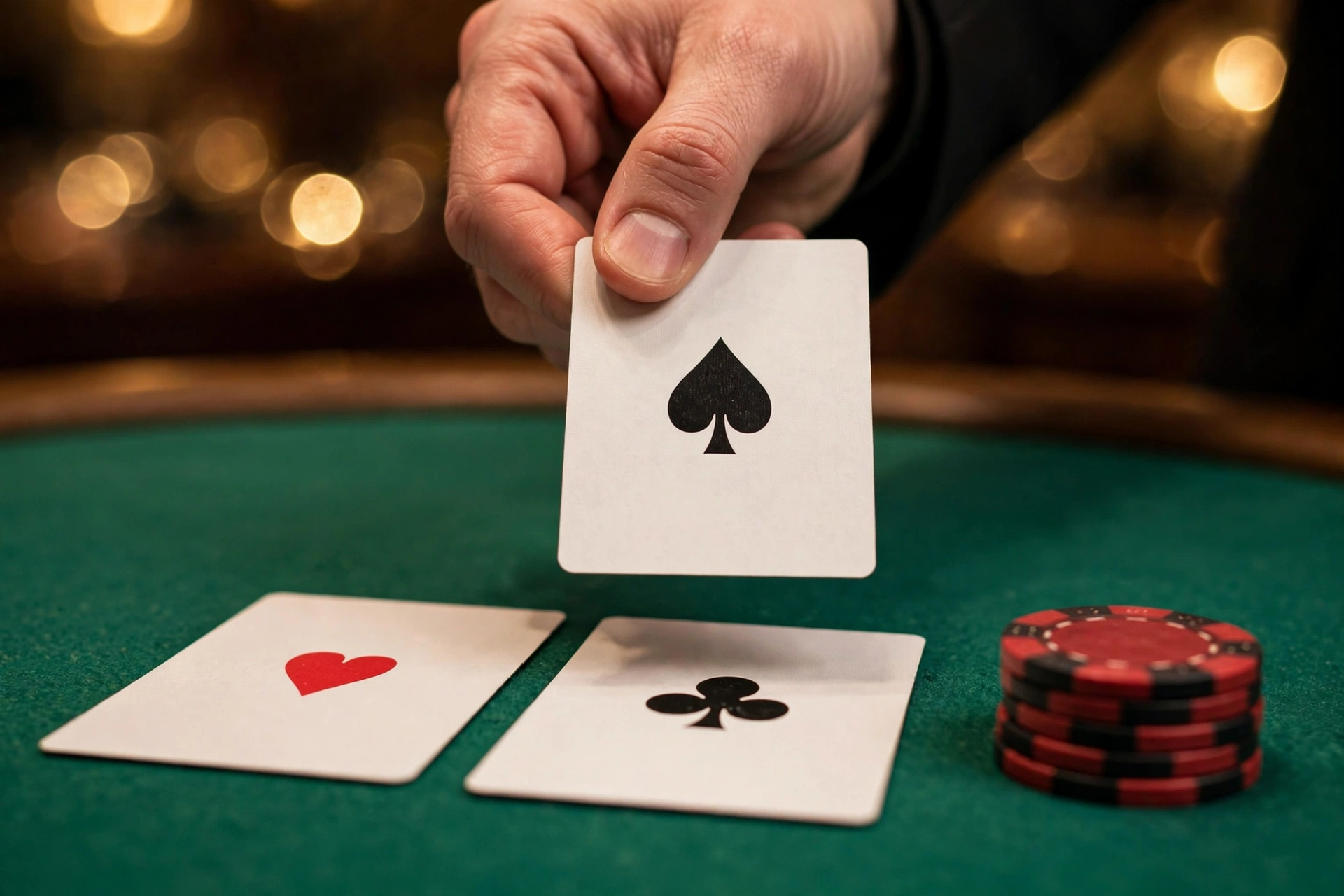
Before deciding whether you should take insurance in blackjack, let’s make sure we’re talking about the same thing — because the name itself is half the con. Insurance has nothing to do with protecting your hand. It’s a separate side bet. Whenever the dealer’s face-up card is an ace, you’re offered the option to bet up to half your original wager that the dealer’s face-down hole card is a ten-value card (a 10, jack, queen, or king), which would give the dealer blackjack.
If the dealer has blackjack, insurance pays 2:1 — your side bet covers the lost main hand and you break even. If not, the insurance money is gone, and your hand plays out normally. The dealer checks for blackjack before anyone plays, so when you’re being offered insurance, the dealer already knows the outcome. You’re betting against someone who already knows the answer.
The genius of the name is that “insurance” sounds defensive. Nobody likes betting to lose — but framed as insurance, you’re not gambling, you’re protecting. That framing is not an accident.
The Night I Took Insurance Four Times in a Row
Here’s my confession: early on, I took insurance constantly. I thought I was being a sharp, careful player — the guy who hedges his risk while the tourists live dangerously.
One night sticks with me. I was up about $300 on $25 hands. The dealer’s upcard was an ace four times in twenty minutes, and I took insurance all four times. The dealer flipped blackjack exactly once; the other three insurance bets — $12.50 each — just vanished. That “careful” habit had quietly eaten half my winnings. That was the night I stopped asking whether I should take insurance in blackjack — and started asking what the math actually said.
What stung most wasn’t the money. It was realizing I’d been paying for a product I didn’t understand, marketed with a word that made me feel clever. The dealer sure wasn’t going to explain it. So consider this article the explanation I needed back then, when I was the confident guy tapping the insurance line.
Why Insurance Feels Like Such a Tempting Bet
Understanding why insurance feels smart is the key to resisting it, because the urge is completely rational on the surface. You’re holding a strong hand — maybe a 20, maybe a blackjack — and the dealer shows an ace. Your brain does a quick, sloppy calculation: the dealer probably has it, my beautiful hand is about to die, surely a little protection is worth it.
Loss aversion does the heavy lifting. Losing a $50 hand to the dealer’s ace feels like the hand was stolen, so paying $25 to “lock in” not-losing feels wise. The casino isn’t selling you a bet; it’s selling you the feeling of not-losing.
There’s social pressure too. When the dealer asks “insurance?” around a full table, half the players tap the line like they’re placing an order, and if you’re new, you follow the confident ones. I did.
The Math the Casino Doesn’t Spell Out
Let’s do the actual arithmetic, because this is where the illusion dies. There’s exactly one question that matters when you ask should you take insurance in blackjack: how likely is the dealer’s hole card to be a ten-value card?
In a fresh single deck, 16 of the remaining 51 cards are ten-value cards — about 31.4%. Multi-deck shoes land in the same neighborhood: roughly 30–31%. Less than one time in three.
Now here’s the thing: insurance pays 2:1. For any 2:1 bet to break even, you’d need to win it more than one time in three. One in three is the break-even point for a 2:1 payout. And the dealer has blackjack less than one time in three.
That gap — between the ~31% chance and the 33.3% break-even — is where the casino’s profit comes from. Over thousands of hands, insurance carries a house edge of roughly 7.4%, one of the worst bets on the floor, versus about 0.5% for a basic-strategy blackjack hand.
Think of it this way: if someone offered you a bet where you risk $25 to win $50 but only win 31% of the time, you’d walk away. You’d only take it if it were called insurance.
Even Money: The Polite Trap
When you have blackjack and the dealer shows an ace, the dealer often asks: “Even money?” Say yes and you get paid 1:1 immediately instead of the usual 3:2. Guaranteed money, no sweat.
Here’s the secret: even money is insurance wearing a friendlier outfit. You should take insurance in blackjack in this disguised form no more than the obvious one — they’re the same bet, with the same 7% edge.
This one got me for a long time. Even money feels different because no extra chips leave your stack — you’re just accepting a sure thing. But the sure thing is smaller than the fair payout, and that difference is the insurance bet dressed up as common sense. Over the long run, declining even money and letting your 3:2 blackjack ride pays more: the dealer only has blackjack about 31% of the time, and the other 69% you collect the full 3:2.
What Basic Strategy Says (It Says Decline)
Basic strategy — the mathematically optimal way to play every hand, worked out from millions of simulated hands — answers the question should you take insurance in blackjack with one word: decline. Always. Every basic strategy chart ever published says the same thing.
That’s because the insurance decision, made honestly by a non-counting player, is always made in the dark: you have no information about the hole card, so you play the base rate, and the base rate says no.
If you haven’t learned basic strategy yet, it’s the single highest-value thing you can do for your game — worth ten times more than any insurance decision. If you’re fuzzy on the fundamentals it’s built on, our breakdown of the blackjack rules is a good starting point, especially the soft-17 section that trips up most beginners. Nail the fundamentals; the side bets can wait.
One more thing: basic strategy is a defense against your own instincts. Your instincts at a blackjack table are terrible — mine were, yours are, everyone’s are. The strategy exists precisely because human brains are wired to make exactly the mistake insurance represents: overpaying to avoid a scary loss. When the chart says no and your gut says yes, trust the chart. The chart’s answer to should you take insurance in blackjack never changes with the mood at the table: decline.
The One Exception: Card Counters at True Count +3
A counter tracks the ratio of high cards to low cards remaining in the shoe. When enough ten-value cards remain undealt, the dealer’s chance of blackjack rises above break-even — and insurance flips from a bad bet to a good one. The standard threshold is a “true count” of +3 or higher (roughly three extra high cards per deck remaining). That’s when counters take it. That’s the whole exception.
And notice how narrow it is: you need to be actively counting — a skill that takes hundreds of hours to do reliably under casino conditions — and the count needs to hit that specific threshold in that specific moment. A hunch that “a lot of small cards have come out” is not a true count of +3. If you can’t state your running count, your decks-remaining estimate, and your true count right now, the exception does not apply to you.
Myths About Insurance I Used to Believe
I believed every one of these at some point. They cost me money. Let’s clear them out.
Myth: Insurance protects your hand. It doesn’t. Your main bet plays out exactly the same whether you insure or not — it’s a separate side bet with a separate outcome. If the dealer doesn’t have blackjack, your insurance money is gone and your hand is no better or worse for it. Calling it protection is marketing, not mechanics.
Myth: Good, experienced players take insurance. I watched veterans take insurance and assumed they knew something I didn’t. Some had been playing for decades — and making the same mathematical mistake for decades. Time at the table teaches habits, not probability. Players who understand the math decline it every time.
Myth: The dealer tells you when it’s smart. Dealers sometimes nudge players — “you might want insurance on that.” The dealer is not your financial advisor. In many casinos they’re encouraged to suggest insurance because it’s profitable for the house, and some genuinely believe it’s smart because nobody taught them the math either. Friendly doesn’t mean correct.
Better Ways to Actually Protect Your Bankroll
If insurance is off the table, what genuinely protects your money when that dealer ace has you nervous? Four things that actually work.
Play basic strategy on every hand. A 0.5% house edge on a proper basic-strategy game is one of the best deals in the casino, and it comes from the boring work of hitting 16 against a 7 and splitting 8s against a 10. Do that consistently and insurance becomes a rounding error.
Manage your bet size. That ace feels terrifying mostly because you’ve got more money out than you’re comfortable losing. If a $50 hand against an ace keeps you up at night, play $25 hands. Never bet more than 1–2% of your session bankroll on a single hand, and no single scary moment can hurt you. That’s real insurance: a bankroll that absorbs variance.
Play at tables with good rules. A 3:2 blackjack payout instead of 6:5 matters enormously. A dealer who stands on soft 17 instead of hitting matters. Fewer decks matters. Each quietly shifts the edge in your favor — walk past the bad tables; being picky is free money.
Set a stop-loss and a win goal before you sit down. “I’ll leave if I’m down $200, and I’ll leave if I’m up $300.” This does more for your bankroll than any single betting decision, because most blackjack losses don’t come from bad hands — they come from good players playing two hours too long. The most expensive thing at the casino isn’t insurance. It’s staying.
Frequently Asked Questions
Should you take insurance in blackjack if you have a blackjack yourself?
No — and this is where the temptation is strongest. Taking even money or insurance on your blackjack against a dealer’s ace is the same bad bet at roughly a 7% house edge. Decline it and about 69% of the time you’ll collect the full 3:2 payout; the other ~31% of the time you push and lose nothing.
How does insurance work in blackjack?
When the dealer shows an ace, you may place a side bet of up to half your original wager that the dealer’s hole card is a ten-value card. If the dealer has blackjack, insurance pays 2:1, covering your lost hand so you break even. If not, you lose the insurance bet and your main hand plays out normally. (See PokerNews’ breakdown of how insurance works for the full mechanics.)
Why is insurance considered a bad bet?
Because the math doesn’t work. Insurance pays 2:1, which requires the dealer to have blackjack more than one time in three to break even. The hole card is a ten-value card only about 31% of the time — less than one in three — giving the bet a house edge around 7%, roughly fourteen times worse than a basic-strategy blackjack hand.
Is even money the same as taking insurance?
Yes. Accepting even money locks in a 1:1 payout instead of 3:2, and the difference is exactly what the insurance bet would have cost you. Dealers present it as a separate, safer option, but it’s the same bet with the same edge.
When can a card counter take insurance?
Only at a true count of +3 or higher — when the remaining shoe is rich enough in ten-value cards that the dealer’s chance of blackjack exceeds break-even. This requires real counting: a running count, a decks-remaining estimate, and a true-count conversion, not a hunch. For everyone else, the answer to “should you take insurance in blackjack” is always decline.
So let’s land the plane. Should you take insurance in blackjack? For nearly every player, the honest answer is no — decline it (the answer to should you take insurance in blackjack never changes), decline even money, and put that money toward what actually matters: basic strategy, sensible bet sizing, and good table rules. The math here isn’t ambiguous: insurance is a 7%-edge side bet dressed up in the language of protection, offered to you by a dealer who already knows the answer.
I spent two years taking insurance because it felt careful and smart. I stopped the day I sat down with the numbers, and the question “should you take insurance in blackjack” hasn’t crossed my mind since. The numbers don’t change with the mood at the table, and neither does the right answer.
The casino’s most profitable moments are the ones that feel the safest. Remember that next time the dealer asks.
Gamble responsibly. 18+ only.
Author

hamzayounus355@gmail.com
Related Posts
Blackjack Hand Signals: How to Talk to the Dealer Without Saying a Word
- 0
- 3,759 words
The first time I learned about blackjack hand signals, it wasn’t from a book or a website — it was from a...
Read out all
How Do Casinos Make Money? The Real Math Behind the Glitter
- 0
- 2,747 words
For years I kept asking myself one question: how do casinos make money when players win jackpots every single night? It started...
Read out all
Why Do Casinos Pump Oxygen? The Myth Everyone Believes
- 0
- 2,665 words
The first time I heard it, I was sitting at a blackjack table at 2 a.m., wired and wide awake, and the...
Read out all
Can Casinos Refuse to Pay Out Winnings? Honest Answer
- 0
- 2,197 words
Can Casinos Refuse to Pay Out Winnings? The Honest Answer Picture this: you hit a jackpot, the machine flashes, the attendant walks...
Read out all
What Is a Casino Whale? Inside the High-Roller World
- 0
- 3,097 words
What Is a Casino Whale? Inside the High-Roller World So what is a casino whale? The first time I heard the term,...
Read out all
How Do Casino Comps Work? The Math Behind the Free Stuff
- 0
- 3,468 words
How Do Casino Comps Work? The Math Behind the Free Stuff So how do casino comps work? I will be honest with...
Read out all
1 comment