- 2
- 2,234 words
The first time I had to figure out how to play three card poker, I was standing at a half-empty table on a slow Tuesday night, staring at the three betting circles in front of me and pretending I understood what any of them were for. I did not. A kind dealer took one look at my face, laughed gently, and explained the entire game in about two minutes. That is genuinely how simple this game is — and why it became one of my favorite table games. It is fast, it is easy to pick up, and unlike blackjack, you do not need a strategy chart memorized to hold your own. In this guide I will walk you through everything the way I wish someone had walked me through it: the rules, the two bets, the strange hand rankings, the one strategy rule you need, and the beginner mistakes that drain your wallet.
Table of Contents
How to Play Three Card Poker: The Absolute Basics
Three Card Poker was invented by Derek Webb in the 1990s — one of the rare modern casino games that actually stuck — and uses a standard 52-card deck. The premise could not be simpler: you get three cards, the dealer gets three cards, and your hand goes up against the dealer’s. There are no community cards, no drawing extra cards, and no bluffing against the other people at the table. Everyone is playing their own separate little battle against the house.
Once you have played a few hands, how to play three card poker becomes second nature, but the betting layout confuses almost every first-timer. Before any cards come out, you will see three circles printed on the felt in front of your seat: Pair Plus, Ante, and Play. The Pair Plus circle is for an optional side bet on the strength of your own three cards. The Ante circle holds your main bet against the dealer. The Play circle starts out empty — you only put chips there after you have seen your cards and decided your hand is worth fighting with. A full hand takes about a minute — part of the charm, and part of the danger.
Pair Plus vs. Ante: The Two Ways to Bet
Here is the thing most beginners miss: when you are learning how to play three card poker, you are really learning two mini-games that run at the same time, and you can play either one or both.
Pair Plus is the side bet, and it is beautifully simple. You put chips in the Pair Plus circle, you get your three cards, and if you have a pair or better, you win — no matter what the dealer is holding. The dealer could have a straight flush and it would not matter; your pair of kings still gets paid. The payout table is printed right on the felt, and at most casinos it looks like this: a pair pays 1 to 1, a flush pays 3 to 1, a straight pays 6 to 1, three of a kind pays 30 to 1, and a straight flush pays 40 to 1. The catch is that you will lose this bet most of the time, because the vast majority of three-card hands are complete junk.
Ante and Play is the main event. You place an Ante bet, receive your three cards, and then you face a decision: fold and surrender your Ante, or slide an equal-sized bet into the Play circle and take your hand to showdown against the dealer. Now here is the twist that trips everyone up the first time: the dealer’s hand must “qualify” with queen-high or better. If the dealer fails to qualify, your Ante wins even money and your Play bet is simply returned to you as a push. If the dealer qualifies and your hand is better, both bets pay even money. If the dealer qualifies and beats you, you lose both bets. Many tables also pay an Ante bonus on strong hands — typically 1 to 1 for a straight and 4 to 1 for three of a kind — even if the dealer beats you.
Three Card Poker Hand Rankings (Yes, They Are Different)
This is the part of learning how to play three card poker that bends your brain if you come from regular poker. The rankings look familiar, but they sit in a different order — because with only three cards, some hands are much harder to make than you would expect. A flush is actually tougher to hit than a straight with three cards, so the straight outranks the flush. Memorize this order from best to worst:
- Straight flush — three cards in sequence, all the same suit (like 5-6-7 of hearts)
- Three of a kind — three cards of the same rank
- Straight — three cards in sequence, mixed suits
- Flush — three cards of the same suit, not in sequence
- Pair — two cards of the same rank
- High card — none of the above; your highest card decides it
That straight-beats-flush swap is the single most misunderstood rule in the game. I once watched a man celebrate his flush over another player’s straight, and the dealer had to break the news to him as gently as possible. Do not be that man. The rankings are usually printed on the felt, so double-check until they stick.
A Real Hand, Step by Step
Let me walk you through a couple of hands so the mechanics click. Picture yourself at a $5-minimum table — and please, start at the cheapest table in the room — with $5 in the Ante circle and $5 in the Pair Plus circle. The dealer slides you three cards face down and deals three to themselves.
You peek: jack, nine, seven, all different suits. Under Pair Plus rules that is nothing, so that $5 is gone no matter what. For your Ante hand, jack-high is borderline — the strategy section will tell you exactly what to do with it. Say you play it and slide $5 into the Play circle. The dealer flips queen, ten, four: queen-high qualifies and beats your jack-high. You lose all three bets — $15 gone in forty seconds.
Now a better one: queen, jack, ten, mixed suits — a straight. Your $5 Pair Plus pays 6 to 1 ($30), and for the Ante decision a straight is a monster, so the $5 Play bet is automatic. The dealer shows king, eight, four — king-high qualifies, but your straight crushes it. Ante pays $5, Play pays $5: you are up $40 on the hand. This is the hand that hooks people.
The Only Strategy You Need: Q-6-4
Here is the beautiful thing about how to play three card poker well: the entire optimal strategy fits in one sentence. Play any hand of queen-six-four or better, and fold everything worse. That is it. That is the whole basic strategy, and mathematicians have confirmed it is essentially perfect.
What counts as “queen-six-four or better”? Your highest card is a queen and your other two cards are at least a six and a four. Q-6-4 is a play, Q-7-2 is a play, Q-6-3 is a fold, and K-2-2 is a play since a king outranks a queen. And just to be clear: any pair or better is an automatic play — the Q-6-4 rule exists for those junky high-card hands where you are genuinely unsure.
Common Beginner Mistakes That Cost Real Money
If you take one lesson from this guide on how to play three card poker, let it be this: beginners lose most of their money to fixable habits, not bad luck.
Playing every hand. This is the most expensive mistake in the game. Folding a 9-5-3 feels cowardly, but playing it is just donating chips to the casino. Trust the Q-6-4 line. The fold button is your friend.
Betting Pair Plus too big. The side bet is the fun part, I know — but its house edge is roughly double the main game’s. Keep it small relative to your Ante, or skip it on hands where you want to stay disciplined.
Misreading the hand rankings. Straight beats flush. I am saying it again because it is the mistake I see most often, and it is completely free to avoid. Check the felt until you have it cold.
Chasing the big payout. The cards have no memory — raising your Pair Plus bet because “a straight flush is due” is superstition, not strategy.
Letting the speed eat your bankroll. Hands take about a minute, and at that pace it is shockingly easy to burn through a hundred dollars without feeling it. Decide your session budget before you sit down, and when it is gone, you are done — no ATM trips, no “one more shoe.”
House Edge: What the Casino Really Keeps
Time for some honest numbers, because understanding how to play three card poker smartly means knowing exactly what you are up against. With correct Q-6-4 strategy, the house edge on the Ante/Play game is about 3.37% — roughly 2% measured against your total action including the Play bet. Either way, it is worse than good blackjack but far better than most carnival-style table games. The Pair Plus side bet, at standard paytables, carries a house edge around 7.28% — more than double the main game. That gap is exactly why I keep my Pair Plus bets small: it is a lottery ticket, not an investment plan.
The analysts at Wizard of Odds have published the full mathematical breakdown if you want it. The practical takeaway: play the Ante game with correct strategy, treat Pair Plus as paid entertainment, and never wager money you cannot afford to lose.
Playing Online vs. at a Real Table
The strategy for how to play three card poker does not change one bit online — same cards, same Q-6-4 rule, same qualifier. What changes is everything around the cards. Online, the game runs much faster: you might play a hundred hands an hour compared to forty at a live table, which means your bankroll swings faster in both directions. The speed is the real danger online, so set strict session limits before you start, and take advantage of free-play mode to drill the hand rankings and the Q-6-4 cutoff until they are automatic.
At a real table, the pace is human, the social energy is half the fun, and the dealer will happily answer questions between hands — seriously, ask. My recommendation: learn the flow at tiny online stakes first, then bring your Q-6-4 confidence to a real table on a quiet weekday afternoon. And if you enjoy quick, simple table games like this one, how to play baccarat for beginners is another easy classic worth adding to your repertoire.
Conclusion
So that is how to play three card poker from zero to confident: three cards each, two ways to bet, a hand-ranking chart with one surprising swap, a single strategy rule in Q-6-4, and the discipline to fold the junk hands without regret. It is genuinely one of the easiest games you can walk up to cold — and now you will not be the person asking what the circles mean, though honestly there is no shame in asking either. Keep your bets modest, keep Pair Plus as the side dish, decide your budget before you sit down, and enjoy one of the fastest, friendliest games on the floor.
Is Three Card Poker hard to learn?
Not at all — it is one of the simplest casino table games you can learn. If you remember that a straight beats a flush and follow the Q-6-4 rule (play queen-six-four or better, fold the rest), you can play competently within minutes.
What does Q-6-4 mean in Three Card Poker?
It is the basic strategy cutoff for the Ante/Play game. You make the Play bet with any hand of queen-high where your other two cards are six and four or better — so Q-6-4, Q-7-2, and K-3-2 are all plays, while Q-6-3 and J-10-8 are folds. Any pair or better is always an automatic play.
Should I play the Pair Plus bet?
That is your call, but go in with open eyes: it is a fun side bet with a house edge around 7%, roughly double the main game’s. I play it small for the entertainment — the occasional 30-to-1 payout is a genuine thrill — but never as my biggest bet.
What happens if the dealer does not qualify?
The dealer needs queen-high or better to qualify. If their hand is worse than that, your Ante bet wins even money and your Play bet is returned to you as a push — you neither win nor lose it. It is one of the quirks that makes learning how to play three card poker so beginner-friendly.
Can you win consistently at Three Card Poker?
No — like every casino table game, the house holds a mathematical edge that no strategy can erase. Correct Q-6-4 play minimizes your expected losses, but over the long run the casino comes out ahead. Play for entertainment with money you can afford to lose, and walk away while you are still having fun.
Gamble responsibly. 18+ only.
Author

hamzayounus355@gmail.com
Related Posts
Blackjack Hand Signals: How to Talk to the Dealer Without Saying a Word
- 0
- 3,759 words
The first time I learned about blackjack hand signals, it wasn’t from a book or a website — it was from a...
Read out all
How Do Casinos Make Money? The Real Math Behind the Glitter
- 0
- 2,747 words
For years I kept asking myself one question: how do casinos make money when players win jackpots every single night? It started...
Read out all
Why Do Casinos Pump Oxygen? The Myth Everyone Believes
- 0
- 2,665 words
The first time I heard it, I was sitting at a blackjack table at 2 a.m., wired and wide awake, and the...
Read out all
Can Casinos Refuse to Pay Out Winnings? Honest Answer
- 0
- 2,197 words
Can Casinos Refuse to Pay Out Winnings? The Honest Answer Picture this: you hit a jackpot, the machine flashes, the attendant walks...
Read out all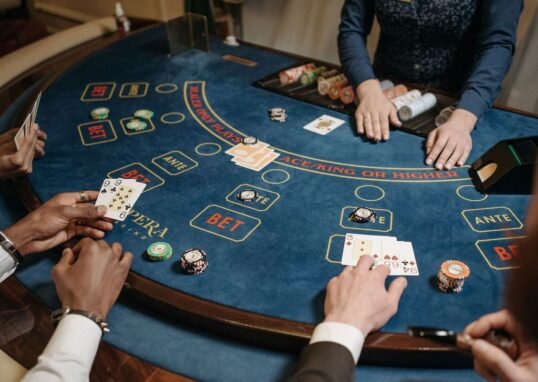
What Is a Casino Whale? Inside the High-Roller World
- 0
- 3,097 words
What Is a Casino Whale? Inside the High-Roller World So what is a casino whale? The first time I heard the term,...
Read out all
How Do Casino Comps Work? The Math Behind the Free Stuff
- 0
- 3,468 words
How Do Casino Comps Work? The Math Behind the Free Stuff So how do casino comps work? I will be honest with...
Read out all
2 comments