
- 0
- 2,112 words
A few years back I had one of those nights every gambler dreams about. I turned a small deposit into nearly €800 on a slot, did the sensible thing, and hit withdraw. I went to bed feeling like a genius. The next morning I checked my casino account — and the €800 was gone. Not in my bank. It was sitting back in my casino balance. What happened? In a moment of late-night weakness, I’d clicked a button labeled “reverse withdrawal” — and barely noticed doing it. So here is casino reverse withdrawal explained in the plainest English I can manage, because this one feature has quietly eaten more winnings than almost any game in the casino.
If you’ve ever requested a cashout and watched the money boomerang back into your account, you know the feeling: confusion, temptation, and that little voice saying “well, it’s already back in there, might as well have one more spin.” That voice is exactly who the reverse withdrawal button is designed for — not you at your sharpest, but you at 1 a.m., with your winnings one click away from the reels again.
Table of Contents
Casino Reverse Withdrawal Explained: What It Actually Means
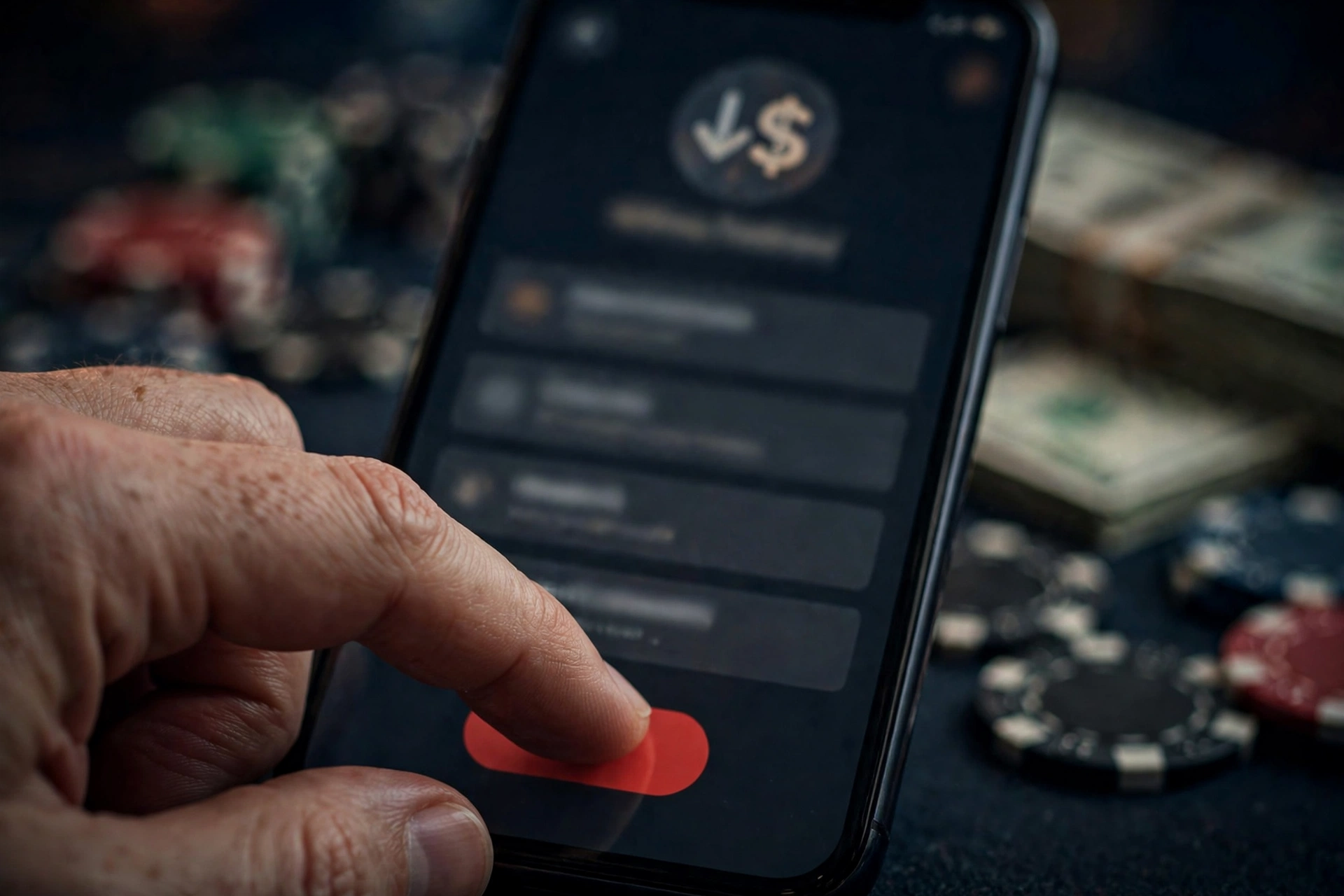
Let’s get casino reverse withdrawal explained properly, starting with the mechanics. When you request a withdrawal at an online casino, your money doesn’t leave instantly. First it enters a “pending” period — usually 24 to 72 hours — while the casino reviews your request. During that window, most casinos show you a button labeled “Reverse Withdrawal” or “Cancel Withdrawal.”
Click it, and the pending withdrawal is cancelled. The money lands straight back in your playable balance, as if you’d never requested the cashout.
That’s the whole feature. It sounds neutral — “flexibility,” “player choice” — but in practice it’s one of the most player-unfriendly features online casinos ever invented. The people who use it aren’t players who withdrew by mistake. They’re players who won and talked themselves into “just a few more spins.” The house edge does the rest.
How the Pending Withdrawal Window Works
To understand why reverse withdrawals even exist, you need to understand the pending window. When you cash out, your money goes through roughly three stages. First, pending: your request sits in a queue, usually 24 to 72 hours, while the casino runs security and identity checks. Second, processing: the casino approves it and sends the funds to your payment provider — at this point the money is gone from your casino account for good. Third, received: it lands in your bank or e-wallet, which can take a few hours to several business days.
Keep this timeline in mind, because casino reverse withdrawal explained in full only makes sense once you see where the trap sits. The reverse button only exists during stage one — once your withdrawal is processing, it’s locked. So the length of the pending window is everything: 72 hours pending is three full days of temptation one click away, while a casino that processes in under 24 hours gives you far less rope.
Why Casinos Make the Reverse Button So Easy to Find
Here’s the uncomfortable truth, and it’s one every casino reverse withdrawal explained guide should state plainly: casinos have zero financial incentive to help you complete a withdrawal. Every reversed withdrawal is money that goes back onto the games, where the house edge grinds away at it. A player who reverses a €500 cashout and plays it back doesn’t just cost the casino nothing — statistically, a chunk of that €500 flows straight back to the house.
This is also why long pending periods make me suspicious. When a casino holds your withdrawal in “pending” for 72 hours while competitors process in under 24, ask what those extra 48 hours are really for. The longer your money sits in limbo, the more chances life gives you to reverse it.
The Loss-Chasing Trap: How Reverse Withdrawals Eat Winnings
Let me describe the classic reverse withdrawal story, because I’ve lived it. You win, you feel disciplined, you withdraw. Then a few hours pass and the itch arrives. You open the casino “just to check” whether the withdrawal went through. It’s still pending. And there’s the button. You tell yourself you’ll just reverse a small portion — but you can’t reverse “a portion”; it’s all or nothing. So you reverse the whole thing, planning to re-withdraw later.
You know how this ends. The re-withdrawal never happens. The money goes back through the games, the house edge does its quiet work, and by morning the win is a memory. If there’s one image to carry away from this whole casino reverse withdrawal explained guide, it’s that moment: the win, already secured, being voluntarily handed back.
This is loss-chasing in its purest form, except you’re not even chasing losses — you’re un-winning your wins. Money in your casino balance doesn’t feel like real money; it feels like points, like ammunition. Money in your bank account feels real. The reverse button sits exactly at the boundary between those two feelings, and it lets you slide back into the unreal-money mindset with one click. The cruelest part? The player who reverses usually knows better. It’s a moment-of-weakness problem — and the casino has placed the button exactly where your weakest moment will find it.
The UK Banned It: What the Gambling Commission Decided
This is the part of the story that tells you everything about how serious the problem is. The UK Gambling Commission looked at reverse withdrawals and decided the feature had to go. Completely.
In 2020, during the first COVID lockdowns, the Commission told operators to stop offering reverse withdrawals as an emergency measure. Then it made the ban permanent: from 31 October 2021, reverse withdrawals have been prohibited for all gambling operators licensed in Great Britain. You can read the Commission’s own announcement here: the Gambling Commission’s official news on the tighter measures.
The reasoning is the moral center of this entire casino reverse withdrawal explained story: the feature exploits a moment of vulnerability — the temptation to gamble with money you’d already decided to take out — and no amount of “player choice” framing justified keeping it. When a regulator bans a feature outright rather than adding warning labels, that’s a strong signal about how harmful they believe it is.
What “Flush” Withdrawals Are (and Why They Matter)
Here’s a term worth knowing: a flush withdrawal. At some online casinos, you can ask customer support — usually via live chat — to “flush” your withdrawal, pushing it straight through the pending stage into processing immediately and skipping the reversible window entirely.
Why does this matter? Because once a withdrawal is flushed, the reverse button disappears. There’s nothing left to reverse. Your money is on its way, and your 1 a.m. self can’t do a thing about it — a way to make the disciplined decision your clear-headed self already made, irreversible.
Not every casino offers flushing, and some that do don’t advertise it — you have to ask. My honest advice: before you deposit at any new casino, open live chat and ask two questions — “Do you offer reverse withdrawals?” and “Can I have my withdrawals flushed?” The answers tell you a lot about whose side the casino is on. Flushing deserves to be in every casino reverse withdrawal explained guide ever written, because it’s the one feature that hands control back to the player.
Practical Advice: How to Keep Your Winnings Safe
So let’s turn all of this into a practical playbook — casino reverse withdrawal explained as actionable advice, not just warnings:
1. Withdraw and close the tab. The single most effective tactic I know, and it’s embarrassingly simple. The moment you request a withdrawal, log out and close the casino site. Don’t “check” on it. Every visit to the cashier during the pending window is an opportunity for temptation.
2. Choose casinos with short pending windows. A casino that processes in under 24 hours gives temptation a much smaller window than one that sits on your money for three days. I wrote more about what to expect in my guide to casino withdrawal pending times — worth a read before you pick where to play.
3. Ask for a flush, every time. If your casino offers it, make flushing part of your routine: request the cashout, open live chat, ask them to flush it. Thirty seconds of effort buys total peace of mind.
4. Set a personal “reverse rule.” Decide in advance — while clear-headed — that you will never reverse a withdrawal, for any reason. Pre-commitment beats willpower.
5. Use the casino’s own safety tools. Deposit limits, loss limits, cooling-off periods — these exist for moments like this. A 24-hour cooling-off period right after a big win is one of the smartest moves a player can make.
6. Never reverse “just to play a little.” This is the lie that starts every reverse-withdrawal disaster story. If you want to keep playing, deposit fresh money you’d planned to spend — don’t cannibalize a withdrawal your past self already made.
What to Do If Your Casino Still Offers Reverse Withdrawals
If you’re playing outside the UK — which most of the world’s players are — there’s a good chance your casino still has the reverse button in the cashier. Don’t panic; plenty of decent casinos still offer it because their jurisdiction allows it. What matters is how you handle it: flush when you can, close the tab always, and treat the reverse button like it doesn’t exist. It’s also worth asking support whether they can disable reversals on your account — some casinos will do this on request even if they don’t advertise it.
And if you’re choosing a new casino anyway, let this be a selection criterion — the final lesson of this casino reverse withdrawal explained guide. Ask about reverse withdrawals and flushing before you deposit, not after you’ve won. The casinos that make withdrawals fast, flushable, and irreversible are telling you something about their priorities — believe them.
Casino Reverse Withdrawal Explained: Your Questions Answered
Is reverse withdrawal the same as cancelling a withdrawal?
Effectively, yes. “Reverse withdrawal” is the industry term for cancelling a pending cashout so the funds return to your playable balance — different casinos just label the button differently.
Why did the UK ban reverse withdrawals?
The UK Gambling Commission concluded the feature exploits vulnerable moments and causes players to gamble away money they’d already decided to withdraw. The ban became permanent for all GB-licensed operators from 31 October 2021.
Can a casino refuse to let me reverse my withdrawal?
In Great Britain, they must refuse — offering the option is banned. Elsewhere, most casinos allow it during the pending window, though a few will disable reversals on your account if you ask.
What is the difference between a reverse withdrawal and a flushed withdrawal?
A reverse withdrawal cancels a pending cashout and returns the money to your balance. A flushed withdrawal does the opposite: it pushes the cashout into processing immediately, so it can no longer be reversed. Flushing is the player-protection version.
Does reversing a withdrawal affect my bonus?
It can. If your withdrawal was tied to a bonus with wagering requirements, reversing may reactivate those requirements. Always check the terms — reversing can create a mess beyond the temptation factor.
How long do I have to reverse a withdrawal?
Only during the pending window, typically 24 to 72 hours depending on the casino. Once the withdrawal moves to processing, it’s locked.
The Bottom Line
Having casino reverse withdrawal explained clearly changes how you see that innocent little button in the cashier. It’s not a convenience feature — it’s a temptation machine, placed exactly where your weakest moment will find it, and it exists because reversed money usually flows back to the house. The UK’s regulator understood this well enough to ban it outright, and that should tell the rest of us everything we need to know.
You don’t need a regulator to protect you, though. Flush your withdrawals when you can. Pick casinos with short pending windows. Withdraw, log out, and close the tab. Decide now — while you’re clear-headed — that a withdrawal, once requested, is final.
Gamble responsibly. 18+ only.
Author

hamzayounus355@gmail.com
Related Posts

Teen Patti Rules for Beginners: The Card Game Every Desi Household Knows (and How to Actually Win)
- 0
- 2,416 words
The first time I sat down at a teen patti table, it was Diwali night at a friend’s house, and I lost...
Read out all
Casino Soft 17 Rule Explained: The Dealer Habit That Quietly Costs You Money
- 0
- 2,440 words
I still remember the night I nearly corrected a blackjack dealer. She was showing ace-six — seventeen, plain as day — and...
Read out all
Provably Fair Gambling Explained: The Crypto Trick That Finally Let Me Check the Math Myself
- 0
- 2,372 words
I will never forget the first time I lost a big crash-game bet and could not stop wondering whether the game had...
Read out all
How to Play Keno for Beginners: The Slow Game I Actually Enjoy
- 0
- 2,282 words
The first time I played keno, I was half asleep in a casino lounge at 1am, waiting for a friend who’d vanished...
Read out all
How to Spot a Fake Online Casino Before It Eats Your Deposit
- 1
- 1,679 word
I still remember the first site that nearly got me. Polished homepage, huge bonus, live chat agent calling me “friend” within ten...
Read out all
What Happens When a Casino Bonus Expires? The Night I Nearly Lost Mine
- 1
- 1,931 word
I still remember the small, cold panic of it. I had a decent bonus sitting in my account, I was more than...
Read out all