
- 1
- 2,862 words
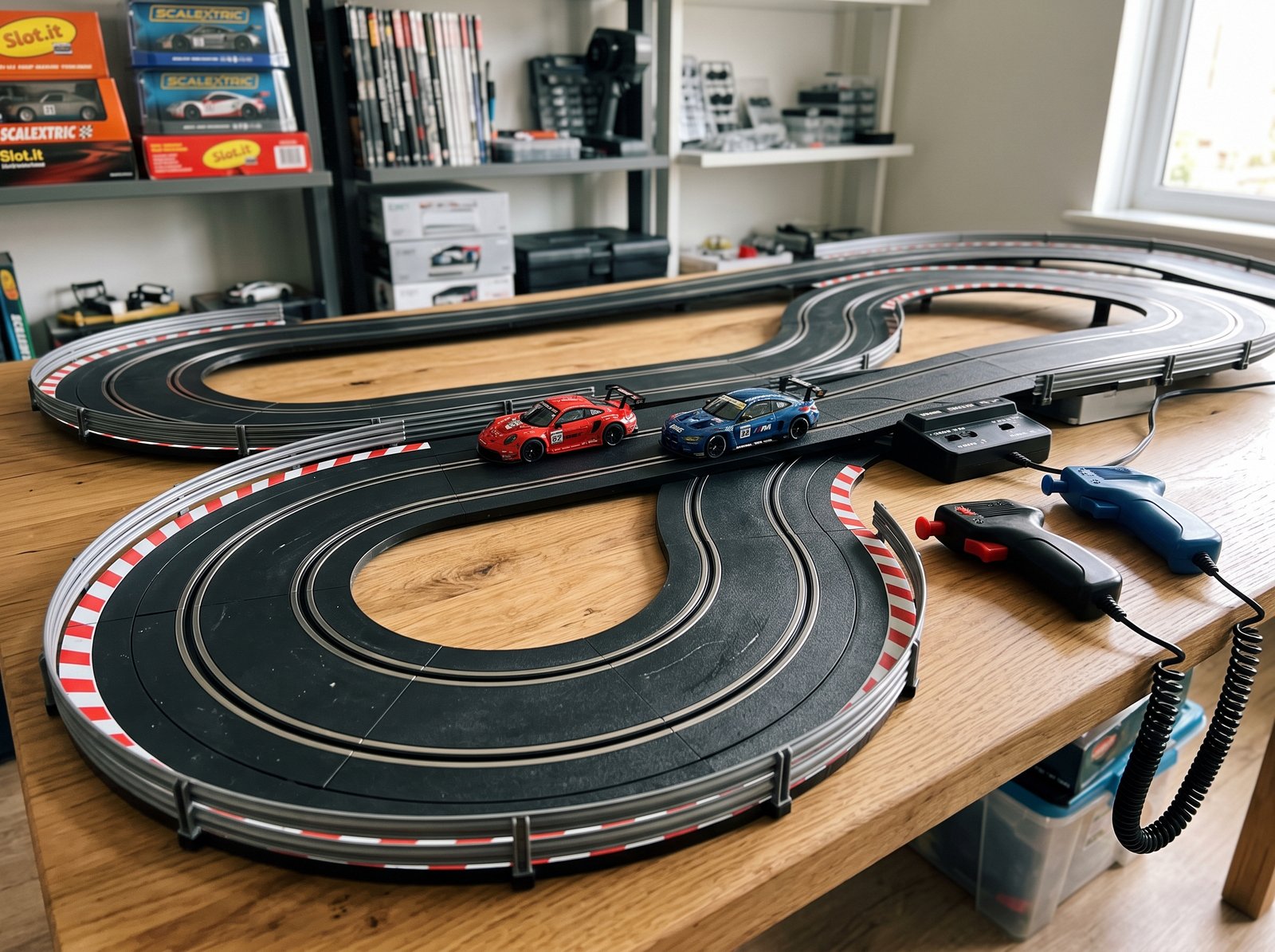
A good slot car track for adults should fit your available space, suit the number of people racing, and have replacement parts you can easily buy. For a beginner, a complete 1:32 analogue set is a sensible starting point for two-person racing. Consider a digital system if you want several drivers sharing lanes, or a compact HO system if space is your main concern.
Table of Contents
The biggest set is not automatically the best choice. A manageable circuit with smooth connections and reachable corners can provide more enjoyable racing than a huge layout that takes too long to assemble.
This guide explains the main systems, the checks to make before buying, and how to build a home circuit you will want to use regularly.
What Makes a Slot Car Track Suitable for Adults?
Slot cars are powered model cars that follow a groove in the track. A guide beneath the car sits in that groove, while electrical contacts collect power from the rails. You control speed with a handheld controller. The challenge is judging how quickly you can approach each bend without leaving the slot. Scalextric explains the guide and electrical pickups in its official car maintenance guide.
An adult setup does not need a special “adults only” label. More useful features include reliable power, comfortable controllers, replaceable tyres, and room to change the layout. Some owners enjoy close racing; others spend more time collecting cars or building scenery.
Decide which part appeals to you before shopping. Someone planning weekly races with friends has different needs from someone who wants a small circuit for occasional solo practice.
How to Choose a Slot Car Track for Adults: 7 Essential Tips
1. Measure the Layout Footprint Before Choosing a Set
Track length and floor space are different measurements. Track length describes the distance around the circuit. The footprint describes how much room the assembled layout occupies.
A box advertising a long racing distance does not tell you whether the track will fit your table. Check the manufacturer’s assembled dimensions and layout diagram. Allow extra space for outer borders, barriers, controllers, and access around the circuit.
For a hypothetical example, a table measuring 2.4 by 1.2 metres, roughly 8 by 4 feet, does not provide that whole area for track. You still need to consider barriers, car overhang, and whether you can retrieve a car from the far side. This is a planning example, not a claim that every set fits that table.
Reach matters as much as size. If a car leaves the slot at a distant corner, you should be able to replace it without leaning on the track. On a deep table, access from more than one side may help.
Also decide where the set will live between races. A permanent board suits a dedicated hobby room. A smaller circuit may be more practical if you must pack everything away after each session.
2. Choose a Scale That Suits Your Room and Interests
Scale describes the model’s size relative to the real vehicle. At 1:32 scale, one unit on the model represents 32 units on the full-size car. For the same real vehicle, a 1:24 model is larger than a 1:32 model.
For this buying guide, 1:32 is the starting recommendation when you want visible car detail and have room for a home circuit. Larger cars can be appealing, but your layout needs to accommodate them. Always check the track maker’s supported car sizes.
HO systems are worth comparing when you want smaller cars and a compact layout. AFX, for example, offers HO sets with cars, controllers, a power supply, and track. Its beginner overview also explains how its sets can be expanded.
Do not assume car scale and track scale always match. Carrera EVOLUTION uses 1:32 cars on track described as 1:24 scale, according to the official EVOLUTION system page. That is why actual layout dimensions matter more than a scale label alone.
3. Pick Analogue or Digital Based on How You Will Race
In a conventional analogue system, each lane has its own control circuit. A standard two-lane home set normally supports two drivers, with each car staying in its assigned lane.
This is a straightforward way to learn braking points and throttle control. It also suits drivers who enjoy racing side by side without setting up digital car identities or lane-change features.
Digital systems let compatible cars receive individual commands, so several cars can share a lane. Lane changes happen at special track sections. You press a controller button to request a change; the cars cannot move sideways anywhere on the circuit.
For example, Carrera DIGITAL 132 supports up to six cars and offers lane changing and adjustable vehicle settings. Those are system capabilities, not a promise that every starter box includes six cars and controllers. Check the official DIGITAL 132 description alongside the exact set’s contents.
Choose analogue if you mainly expect one or two people to race and want a simple setup. Consider digital if sharing lanes and overtaking are central to the experience you want.
Wireless controllers and app features do not, by themselves, prove that a system supports digital lane changing. Read the specification rather than relying on the product name.
4. Check Compatibility Before Buying Extra Cars or Track
Matching scale does not guarantee compatibility. Track connectors, lane spacing, guide dimensions, electronics, and controllers can differ between systems.
Think of compatibility as three separate questions. Will the track pieces join correctly? Will the car physically run on the track? Will its electronics work with the control system?
A “yes” to one question does not answer the others. A car might fit the slot but require a compatible digital decoder before it can run in a particular digital mode. An upgrade-ready car may still need a separately purchased part.
Do not assume different brands’ digital equipment will work together. Before ordering an extra car, confirm the exact car model and the exact powerbase or control unit. Ask the manufacturer or retailer if the listing is unclear.
The same caution applies to older collections. A familiar brand name does not tell you which generation of track or electronics is included. Photograph the connectors and record part numbers before buying replacement sections.
If joining a club interests you, ask which scale, cars, tyres, and controllers it permits before building your home collection around a different system.
5. Compare the Full Setup Cost
The starter box is only one part of the buying decision. Compare what each package includes and what you would need to add for your planned races.
A complete set should clearly list its cars, controllers, power supply, and track. Check whether barriers, borders, timing equipment, or digital lane changers are included or sold separately.
An upgrade kit is not necessarily a complete racing set. For example, Scalextric’s ARC PRO upgrade kit lists a powerbase, two wireless hand controllers, a wall adaptor, and supporting items. Its contents list does not describe a complete circuit with cars.
For a digital group setup, price the extra compatible cars and controllers needed for everyone who will race. Then include any required accessories, a suitable table or board, and basic replacement parts.
Compare delivered prices in your own currency. UK and US listings can differ in tax treatment, shipping, plug type, and included components. International buyers should also check import charges and regional support before choosing a cheaper overseas listing.
Check the supplied adaptor’s input rating and the manufacturer’s regional guidance. A plug adapter alone does not establish electrical compatibility.
6. Prioritise Control and Practical Maintenance
A powerful motor will not make a beginner better at cornering. Look for a setup that allows you to practise smooth acceleration and repeatable laps.
If adjustable speed is offered, check how it works on the exact system. A lower setting can make early sessions less frustrating, especially when drivers have different experience levels.
Consider the cars as well as the track. Highly detailed mirrors and wings may matter to a collector, while a frequent racer may prefer a model with fewer exposed parts. If possible, try the controller before purchasing to check whether its grip and trigger feel comfortable.
Spare parts deserve an early check. Search for the actual tyres, pickups, guides, and controllers used by the set you are considering. A vague promise of “lots of accessories” is less useful than finding the parts you may need.
For second-hand equipment, request clear photographs and a demonstration of both lanes working. Check the condition of track connectors and rails, and confirm that the correct power supply is included. Missing electronic components can make an apparent bargain less attractive.
7. Choose an Expansion Plan You Can Actually Use
Your first circuit should be easy to assemble, learn, and maintain. You can build on it after discovering what you enjoy.
A useful early change might be a different bend, more room beside a corner, or a reliable lap counter. It does not have to be a faster car or a much longer circuit.
Draw a possible future layout before purchasing expansion pieces. Check whether the new shape still fits, whether both lanes close properly, and whether every corner remains reachable.
Be realistic about digital conversion. It may require compatible control hardware, car electronics, lane-changing track, and power equipment. Do not assume a simple controller replacement will provide every digital feature.
For an adult hobby setup, the most valuable expansion is one that improves the kind of racing you already enjoy. Buy it to solve a clear problem or add a wanted feature.
Slot Car Systems Worth Comparing
The following options suit different priorities. This is a comparison of system types and published features, not a hands-on product ranking.
| System | Why consider it? | Main check before buying |
|---|---|---|
| Scalextric 1:32 analogue | A starting point for conventional lane-based home racing | Exact set contents and track family |
| Carrera EVOLUTION | Two-car analogue racing with 1:32 cars | Space required by its 1:24-scale track |
| Carrera DIGITAL 132 | Shared-lane racing, lane changes, and support for up to six cars | Included controllers, cars, and assembled dimensions |
| Scalextric ARC PRO | Digital racing with app-based race management and six-car capability | Complete set versus upgrade kit, car compatibility, and device requirements |
| AFX HO | Smaller cars and an expandable HO track system | Specific layout footprint and local parts supply |
Carrera confirms EVOLUTION’s two-car analogue format in its system overview. Scalextric lists ARC PRO’s six-car capability and race-management features on the upgrade product page. Check individual package descriptions because system-level features do not establish what comes in every box.
For a first purchase, shortlist two systems that fit your room and racing plans. Compare those carefully instead of trying to choose from every model and accessory at once.
Designing a Home Layout That Is Fun to Drive
Start With a Clear, Reachable Circuit
Build the supplied beginner layout first. It gives you a known arrangement for checking assembly and learning how the cars respond.
Once it works reliably, experiment with the rhythm of the circuit. A straight followed by a bend gives you a clear place to practise slowing down. Different corner shapes can then add variety without making the whole layout hard to read.
Avoid placing the most difficult bend beneath a bridge or behind scenery. Hidden corners make it harder to judge speed and retrieve cars. Keep scenery removable until you are happy with the racing.
On an analogue circuit, lanes can have different distances or corner demands. A simple way to make a race meeting fairer is to swap lanes between heats and combine the results.
Leave Space Outside Corners
As a car turns, its rear can swing beyond the edge of the running surface. Compatible borders provide extra surface beside the track; barriers serve a different purpose by helping contain a car.
Check the recommended borders for your track and car combination. This matters especially when changing to larger cars or experimenting with setups that allow more sliding.
Do not place an exposed tabletop corner directly beside a large drop. Plan the track position and containment before racing at full speed.
Choose a Stable Base
A flat, supported surface helps sections stay aligned. If using a table, check that it does not wobble when someone operates a controller or retrieves a car.
A temporary floor layout can help you test the available space, but keep it away from foot traffic. Before each session, inspect it for dust, loose connections, and objects near the slots.
If making a removable board, plan how you will lift and store it before adding track and scenery. Consider its finished size and weight, and keep power cables clear of walking routes.
Setting Up Your First Race
Lay out the pieces with the power disconnected. Follow the set’s assembly diagram and connect sections gently. If a joint does not sit properly, inspect it rather than forcing it into place.
Install the correct power supply and controllers according to the manual. For digital equipment, complete the required car and controller pairing before starting a race.
Test one car slowly around the full circuit. Then test the other lane or car. This makes it easier to spot a connection problem before several drivers start at once.
For a hypothetical first race, use a short practice session followed by equal timed heats. Give each driver a turn in each analogue lane. Agree beforehand whether the race pauses when a car comes off, or whether another person replaces it while racing continues.
Choose similar cars when you want to compare driving skill. If one driver uses a much easier or faster car, swapping cars between heats can help keep the evening friendly.
Your first goal should be finishing several laps without leaving the track. Build speed gradually after you can repeat that performance.
Maintenance and Common Problems
Dust, worn pickups, and dirty tyres can spoil a session that otherwise has a good layout. Use the maker’s care instructions for your exact equipment, and disconnect power before cleaning or adjusting the track.
Scalextric recommends keeping braids aligned with the rails and cleaning rear tyres with a slightly damp cloth before drying them. Its maintenance instructions provide model-related guidance. Avoid transferring one maker’s cleaning method to another product without checking suitability.
If a car repeatedly stops at the same place, inspect that section and its connections. If the fault follows one car around an otherwise working circuit, check that car’s pickups, guide, and wheels.
If cars leave the track at the same bend, reduce entry speed first. Then inspect the joint, support beneath the section, and space beside the corner. Do not assume every crash means the car needs an upgrade.
If a digital lane change fails, use the manual to check car assignment, track orientation, and the relevant sensor or pickup area. Change one thing at a time so you can identify what solved the problem.
Frequently Asked Questions
Can you enjoy slot car racing alone?
Yes. You can practise clean laps, learn braking points, and compare your times if you have suitable timing equipment. Solo driving is also useful for testing a new layout before inviting friends.
Is a longer track always better?
No. Extra length is useful only if it adds enjoyable driving and still fits your space. A shorter circuit that is easy to see, reach, and maintain may get more use.
Should beginners build a custom wooden track?
A custom track can be a rewarding project, but it adds design, woodworking, wiring, and surface preparation to the hobby. A modular starter set lets you discover your preferred layout and racing style before taking on that work.
Do you need an app to race?
That depends on the product and which features you want. Check the manual for basic operation, timing, and race management separately. If an app is important to the set, verify current compatibility with your phone or tablet before buying.
Choose a Track You Will Enjoy Using Regularly
The right slot car track for adults balances space, control, and room to grow. A complete analogue set is a practical starting choice for simple two-person racing. Digital is worth considering when shared lanes and overtaking matter to you, while an HO system deserves a look when you prefer smaller cars.
Measure your space, decide how many people will usually race, and compare two compatible starter systems. Before buying, confirm the contents, regional power supply, and replacement parts. Start with a manageable layout, learn it well, and expand when you know what will make your next race more enjoyable.
Author

hamzayounus355@gmail.com
Related Posts

Boxyard RTP: 7 Essential Things for a Great First Visit
- 0
- 3,017 words
If you searched for Boxyard RTP, the first thing to know is that this is not a casino term or a reference...
Read out all
Free Slot Games: A Beginner’s Guide to Demo Slots and Safer Play
- 1
- 3,800 words
Free slot games let you try slot-style games without staking your own money. In most true demo versions, you receive virtual credits...
Read out all
Poker Hands: 10 Winning Rankings Every Player Must Know
- 1
- 5,024 words
poker handsUnderstanding poker hands is one of the first and most important steps toward becoming a confident poker player. Whether you are...

Poker Regeln: Die wichtigsten Regeln für Anfänger und sichere Gewinne
- 0
- 6,121 words
Poker is one of the most popular card games in the world, but getting started can feel confusing when you first encounter...

NV Casino Online Login: 7 Easy Steps to Sign In, Recover Your Account and Play Safely
- 0
- 4,400 words
The NV Casino online login process is designed to give registered players quick access to their accounts from a computer or mobile...

Slot Magie: Discover Exciting Online Slots, Smart Strategies, and Winning Entertainment
- 0
- 5,083 words
Online casino gaming has changed dramatically over the years, but slot games continue to hold a special place in the world of...
1 comment