
- 0
- 2,440 words
I still remember the night I nearly corrected a blackjack dealer. She was showing ace-six — seventeen, plain as day — and instead of turning her hand over, she tapped the felt for another card. I opened my mouth, sure she had made a mistake, when the old regular next to me chuckled without looking up from his chips. “House hits soft seventeen here, kid. Read the felt.”
I had been playing blackjack for months and had never had the casino soft 17 rule explained to me, not once — to the regulars it was wallpaper. But that one extra card changed everything, and over the evening I watched dealers turn soft seventeens into twenty-ones with a frequency that started to feel personal.
It was not personal, of course. It was arithmetic. So here is the casino soft 17 rule explained the way I wish someone had laid it out for me that night: what “soft” means, why the house insists on it, exactly how much of your money it costs, and the small strategy adjustments that take most of that cost back. It is one of the smallest-print rules in the casino, and one of the most expensive to ignore.
Table of Contents
Casino Soft 17 Rule Explained: What “Soft” Actually Means
Having the casino soft 17 rule explained properly starts with the word “soft” itself, because it has nothing to do with how the cards feel and everything to do with the ace.
An ace is the only card in blackjack with two values: one or eleven, whichever helps the hand more. A “soft” total is any hand where the ace is being counted as eleven without busting. Ace-six is the famous one — soft seventeen — but ace-two through ace-six (soft thirteen through soft sixteen), ace-seven (soft eighteen), and ace-eight (soft nineteen) are all soft hands. The defining feature of a soft hand is that you cannot bust it with a single card: draw a ten on ace-six and the ace simply drops to a value of one, leaving you with hard seventeen.
A “hard” seventeen, by contrast — say, ten-seven, or nine-eight — has no ace doing acrobatics. One more card can kill it. That difference is the entire reason the soft seventeen rule exists. Hitting a hard seventeen is suicide, because eight of the thirteen card ranks bust you on the spot. Hitting a soft seventeen is free: the worst possible outcome is that you stay at seventeen or drop to a hard total between twelve and sixteen, and the best outcome is a straight improvement. When the dealer is forced to take that free shot every single time, the math tilts — and it tilts toward the house.
H17 vs S17: How to Read the Felt
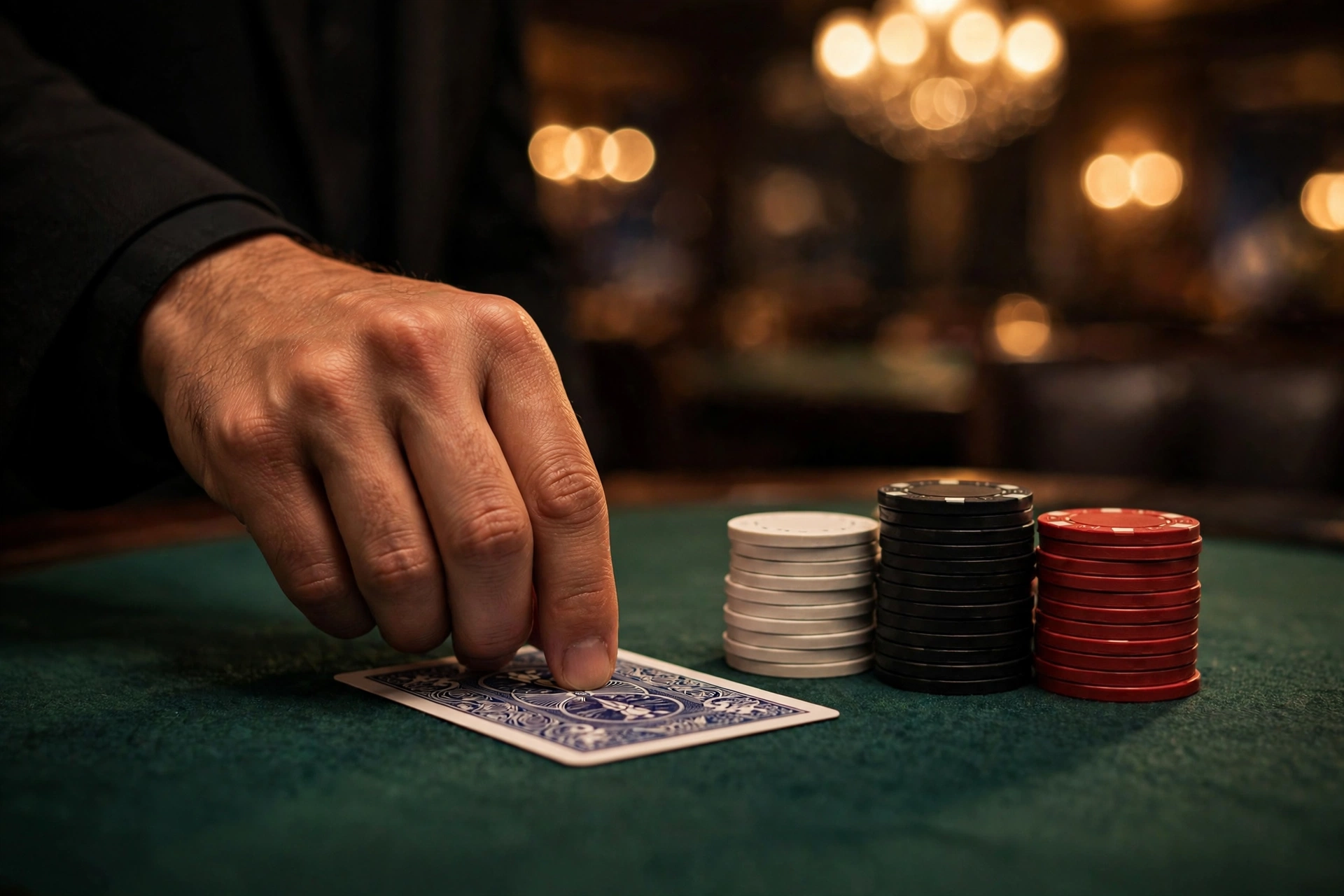
Every blackjack table carries its dealer rules in small print on the felt, and the two versions of this rule have their own shorthand. “S17” means the dealer must stand on all seventeens — ace-six included, no extra card. “H17” means the dealer must hit soft seventeen: ace-six gets one more card, while hard seventeen and above still stand.
The felt usually phrases it in plain language: “Dealer must stand on all 17s” is the S17 game, and “Dealer must hit soft 17” is the H17 game. That single line is the casino soft 17 rule explained in casino shorthand, and it is worth hunting for before you sit down, the same way I learned to check a table’s posted limits and rules before buying in. Two tables can sit side by side, identical in every way — same minimums, same payouts, same number of decks — and differ only in those five words.
Until an ace-six lands in front of the dealer, the two games feel identical — the rule fires on only a small fraction of dealer hands, but over thousands of hands it fires relentlessly, and the house built its edge calculations counting every one of them.
Why the House Insists on the Extra Card
Casinos do not leave money on the table out of politeness, so the first question I asked was the obvious one: why would the house voluntarily take a card on seventeen, the hand every basic-strategy chart tells players to stand on?
Because the dealer’s seventeen is not your seventeen. When you stand on hard seventeen, you do it because hitting is likely to bust you. The dealer with ace-six faces no such danger. Roughly speaking, the dealer improves that hand about a third of the time — drawing an ace through five to make eighteen through twenty-one, or drawing a ten-valued card to land right back on hard seventeen — and never busts. It is a free roll, and the casino takes every free roll it can get.
This is not the dealer’s choice — the rule is printed on the felt, drilled in training, and enforced by the pit. The dealer who tapped for that card on my first night was not being aggressive; she was following a script written by people who had run the numbers on millions of simulated hands. The house does not care about any individual hand. In the aggregate, hitting soft seventeen prints money.
How Much It Costs You: The Edge in Plain Numbers
This is the part where the casino soft 17 rule explained in percentage terms stops being trivia and starts being a budgeting decision. Switching a blackjack game from S17 to H17 — changing nothing else — raises the house edge by about two-tenths of a percent, roughly 0.2%.
Two-tenths of a percent sounds like nothing. Here is what it actually means: on a game where basic strategy already holds the house edge to around half a percent, the H17 rule inflates the casino’s advantage by nearly half again. If you are betting twenty-five dollars a hand for a few hours, that extra 0.2% quietly siphons off several dollars you would have kept at the S17 table next to it — the identical-looking one. I cross-check the exact figures in the Wizard of Odds blackjack appendix, which lays out the house edge for every rule combination imaginable, and H17’s cost is consistent across deck counts.
To put it in perspective, 0.2% is bigger than the difference between a six-deck and an eight-deck game. Players will hunt the floor for a 3:2 blackjack payout instead of 6:5 — rightly so — and then sit at the first H17 table they find without a glance at the felt. Rule-shopping is a habit, and the soft seventeen line is the easiest win on the board: same game, same strategy, less tax.
What It Changes in Your Strategy
Here is the twist most guides bury: the casino soft 17 rule explained fully does not just change what the dealer does — it changes what you should do, because your decisions are calibrated against the dealer’s tendencies.
The core of blackjack basic strategy stays the same either way. You still hit your soft eighteen (ace-seven) against a dealer nine, ten, or ace, because eighteen loses to the dealer’s likely nineteen-plus too often to stand pat. You still double your soft thirteen through soft sixteen against weak dealer upcards. Those plays do not move.
What moves are the aggressive doubling spots, and they move in exactly the places where the dealer’s extra card makes your edge slightly better:
- Soft eighteen (ace-seven) against a dealer two: at an S17 table you stand; at an H17 table you double down. The dealer’s forced hit on soft seventeen makes your eighteen relatively stronger, tipping the math just past the doubling threshold.
- Soft nineteen (ace-eight) against a dealer six: at an S17 table you stand; at an H17 table you double. Same logic — the dealer busts or improves from a weaker position often enough that getting more money out with nineteen showing is correct.
- Surrender spots widen slightly: in games that offer surrender, H17 basic strategy surrenders hard fifteen against a dealer ace (in addition to the usual spots), because the dealer’s ace is marginally more dangerous when soft seventeen gets another card.
Three small adjustments, and here is the practical headache: most strategy cards are printed for one game or the other, and players memorize the wrong one. If you learned on S17 charts and sit at an H17 table, you will leave those two doubles on the table every session — the exact spots where the rule gives you a chance to fight back. Check which game you are playing before you trust your memory.
The Mistakes I Watch Players Make Every Session
Once you have had the casino soft 17 rule explained, you start seeing its casualties everywhere. These are the ones I notice most:
Treating soft seventeen like hard seventeen. A player gets ace-six, hears “seventeen,” and stands — sometimes even against a dealer six, where doubling is the textbook play. Seventeen is not seventeen. Soft seventeen is a drawing hand wearing a made hand’s clothes.
Standing on soft eighteen against a dealer nine or ten. “Eighteen is a good hand” is wrong here: the dealer’s nine or ten makes nineteen-plus far too often, so your soft eighteen needs the free hit.
Refusing to double soft hands. Doubling ace-seven against a dealer five feels reckless to beginners, but the inability to bust makes soft doubles some of the most profitable plays in the game.
Never checking the felt. The most expensive mistake is also the most boring: sitting down without reading the table rules. Players will ask the dealer about the minimum bet, the payout on blackjack, whether they can split aces twice — and never ask the one question printed in the smallest type. Five seconds of reading is worth more than an hour of perfect play at the wrong table.
Spotting the Rule: Online Tables vs the Real Felt
The casino soft 17 rule explained on a screen looks different from the way it reads on felt, but it is always disclosed somewhere — you just have to know where casinos hide it.
In a land-based casino, it is printed on the layout itself, usually in an arc of small text near the dealer’s side: “Dealer must hit soft 17” or “Dealer must stand on all 17s.” If the felt is worn or the print is genuinely missing, ask the dealer before you buy in. They answer this question fifty times a day and will not think twice about it.
Online, the rule lives in the game’s information or rules tab — the little “i” or “?” icon most players never click. RNG blackjack games (you against the computer) almost always spell out H17 or S17 in the rules page, and in my experience the default online game is H17 far more often than in a good land-based pit. Live dealer tables usually show the rule in the table description in the lobby, sometimes as a literal “H17” or “S17” tag next to the table name, which makes shopping for S17 games online genuinely easy if you bother to look.
One caveat: the soft seventeen rule is not the first thing to check. A 6:5 payout instead of 3:2 costs roughly seven times what H17 does, and it is depressingly common online. My checklist runs in order of damage: blackjack payout first, then H17 versus S17, then doubling and splitting rules. The soft seventeen line is the easiest upgrade — after you have cleared the big one.
The Bottom Line
So that is the casino soft 17 rule explained from every angle that matters: “soft” means the ace is counting as eleven and the hand cannot bust in one card; H17 tables force the dealer to take a free improvement shot on ace-six while S17 tables let it stand; that free shot costs you about 0.2% in house edge; and the correct response is not outrage but adjustment — a couple of extra doubles and the discipline to always read the felt before you sit.
I still think about that dealer from my first night, tapping the felt on ace-six while I sat there with my mouth open. She was not bending the rules — she was the rule, printed right in front of me the whole time. These days I check before I sit and double my ace-seven against a deuce at H17 tables without flinching. Small print, real money. That is blackjack in a sentence.
Is soft 17 good for the player?
No. In the casino soft 17 rule explained the way casinos actually write it, H17 (dealer hits soft 17) is good for the house, not for you — it adds roughly 0.2% to the house edge compared to S17. The confusion comes from the player’s side: soft seventeen is a fine drawing hand for you because you can hit it for free, but when the dealer gets the same free draw on every ace-six, the math favors the house.
Does the dealer always hit soft 17?
Only at H17 tables, where the felt or the rules page says “dealer must hit soft 17.” At S17 tables the dealer stands on all seventeens, including ace-six. It is a fixed house rule, not dealer discretion — the same dealer will play it the same way every time at a given table.
What do H17 and S17 mean on the felt?
H17 means “hit soft 17”: the dealer takes another card on ace-six. S17 means “stand on all 17s”: the dealer stands on ace-six just like any other seventeen. The letters are casino shorthand for the full sentences usually printed nearby on the layout.
Should I double down on soft 17?
Against a dealer three through six, yes — doubling ace-six is standard basic strategy at both H17 and S17 tables, because you cannot bust and the dealer is weak. That is exactly the kind of adjustment the casino soft 17 rule explained demands: treat soft seventeen as a drawing hand, not a standing hand.
Does the soft 17 rule matter at online casinos?
Yes, arguably more, because online blackjack defaults to H17 more often than good land-based games do. The upside is that online tables usually label the rule clearly in the rules tab or the live lobby, so finding an S17 game takes seconds once you know to look. Always check before your first bet, not after your first losing session.
Gamble responsibly. 18+ only.
Author

hamzayounus355@gmail.com
Related Posts

Teen Patti Rules for Beginners: The Card Game Every Desi Household Knows (and How to Actually Win)
- 0
- 2,416 words
The first time I sat down at a teen patti table, it was Diwali night at a friend’s house, and I lost...
Read out all
Provably Fair Gambling Explained: The Crypto Trick That Finally Let Me Check the Math Myself
- 0
- 2,372 words
I will never forget the first time I lost a big crash-game bet and could not stop wondering whether the game had...
Read out all
How to Play Keno for Beginners: The Slow Game I Actually Enjoy
- 0
- 2,282 words
The first time I played keno, I was half asleep in a casino lounge at 1am, waiting for a friend who’d vanished...
Read out all
How to Spot a Fake Online Casino Before It Eats Your Deposit
- 1
- 1,679 word
I still remember the first site that nearly got me. Polished homepage, huge bonus, live chat agent calling me “friend” within ten...
Read out all
What Happens When a Casino Bonus Expires? The Night I Nearly Lost Mine
- 1
- 1,931 word
I still remember the small, cold panic of it. I had a decent bonus sitting in my account, I was more than...
Read out all
Casino Bankroll Management Tips That Actually Saved My Sessions
- 1
- 2,293 words
I still remember the night my balance vanished in under an hour. I had deposited a sensible amount, picked a slot I...
Read out all