
- 0
- 4,589 words
If you are learning poker for the first time, the cards are only part of the challenge. You also need to understand the language used around the table. Poker terms such as blinds, flop, three-bet, nuts, kicker, bubble, and tilt can sound confusing when nobody explains them in simple English.
Table of Contents
This beginner-friendly guide explains 75 important poker terms you are likely to hear in Texas Hold’em, tournaments, cash games, online poker, and live poker. You do not need to memorise everything at once. Start with the basic actions such as check, call, raise, and fold, then learn positions, hand names, draws, and tournament vocabulary.
Poker terminology can differ slightly between games and card rooms, but most of the terms below are widely used. PokerStars Learn maintains a broad reference covering many of these standard definitions. PokerStars Learn poker terms glossary PokerNews also uses the same core terms in its beginner explanation of how poker is played. PokerNews beginner poker rules
Before playing poker for money, remember that gambling involves financial risk. It should not be treated as a reliable way to make money. The UK Gambling Commission specifically advises against using gambling to improve personal finances. Laws, age limits, and availability also differ between countries and regions.
Basic Poker Terms Every Beginner Should Learn
These first poker terms describe the cards, chips, and important parts of a poker table.
1. Hand
A hand can mean two things. It can describe one complete round of poker, from the cards being dealt until the pot is awarded. It can also mean the five-card combination a player uses to determine the strength of their cards.
For example, if you make a pair of aces, you may say, “I have a pair,” referring to your poker hand.
2. Hole Cards
Hole cards are the private cards dealt to an individual player.
In Texas Hold’em, each player receives two hole cards. Other players cannot normally see them until they are shown at showdown.
For example, A♠ K♣ may be your two hole cards.
3. Community Cards
Community cards are cards placed face up in the centre of the table that eligible players can use.
Texas Hold’em eventually has five community cards: three on the flop, one on the turn, and one on the river.
4. Board
The board is another name for the community cards currently visible on the table.
If the flop is A♣ 9♦ 4♠, a player might say, “There is an ace on the board.”
5. Pot
The pot contains the chips or money being contested during a hand.
Bets and calls are added to the pot. When the hand ends, the pot is awarded according to the rules of the game.
A player should not confuse the pot with their personal stack.
6. Stack
Your stack is the collection of chips you currently have available at the table.
If you begin a tournament with 20,000 chips, your starting stack is 20,000.
A player’s stack size often affects the decisions they can make.
7. Dealer Button
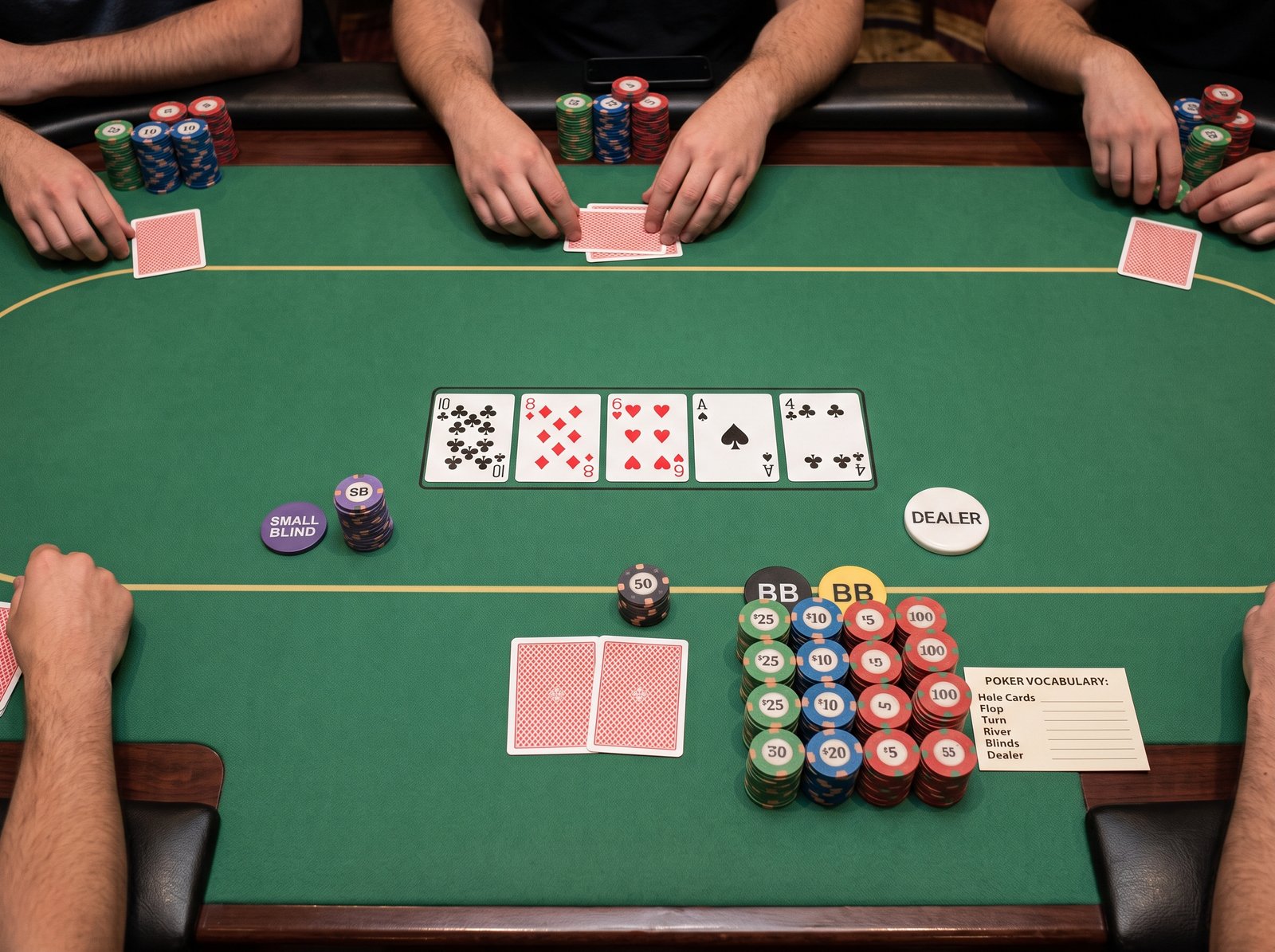
The dealer button, usually called the button, is a marker showing the nominal dealer position in games such as Texas Hold’em.
It normally moves one seat around the table after each hand. The button is important because betting position is based partly on where players sit in relation to it.
8. Blinds
Blinds are forced bets used to begin the action in games such as Texas Hold’em.
They ensure that there are chips in the pot before players voluntarily bet. The two standard blinds are the small blind and big blind. PokerNews provides a useful beginner explanation of the button and blinds. PokerNews guide to the button and blinds
9. Small Blind
The small blind is one of the forced bets made before the cards are played.
In a standard Hold’em structure, the player immediately to the left of the button posts the small blind.
10. Big Blind
The big blind is the second main forced bet in Hold’em.
It is normally posted by the player to the left of the small blind and is generally larger than the small blind.
The size of the big blind is also commonly used when discussing stack depth. For example, someone may describe a tournament stack as “30 big blinds.”
Poker Terms for Betting and Player Actions
Knowing betting language is essential because these words tell you what a player is doing with their chips.
11. Bet
A bet is the first voluntary placement of chips into the pot during a betting round when no previous player has bet.
For example, if everyone checks to you on the flop and you put 10 chips into the pot, you have made a bet.
12. Check
To check means to remain in the hand without betting.
You can normally check only when no bet requiring a response has been made during that betting round.
If another player has already bet, you usually need to call, raise, or fold instead.
13. Call
To call means to match the current bet or raise so you can remain in the hand.
If an opponent bets 20 chips and you put in 20 chips, you have called the bet.
14. Raise
A raise means increasing the amount another player has already bet.
If a player bets 20 and you increase the wager to 60, you have raised.
The minimum and maximum legal raise can depend on the betting structure and house or tournament rules.
15. Re-Raise
A re-raise happens when someone raises after another player has already raised.
For example, one player bets, a second raises, and a third increases the wager again.
Modern poker players often use terms such as three-bet and four-bet to describe these actions more precisely.
16. Fold
To fold means to give up your hand and stop competing for the current pot.
After folding, you normally cannot win that pot even if your cards would later have made the strongest combination.
Learning when to fold is one of the most basic parts of poker.
17. All-In
A player is all-in when they commit all of their remaining chips to the current hand.
They cannot make additional bets because they have no chips remaining in their stack.
If other players still have chips, further betting may create a side pot.
18. Limp
To limp usually means entering a pot before the flop by calling the big blind rather than raising when no one has raised before you.
For example, with blinds of 1/2, calling 2 as your first action may be described as limping.
19. Open-Raise
An open-raise is the first raise made before the flop when no player has previously entered the pot with a call or raise.
For example, if everyone folds to you and you raise from 2 to 6, you have open-raised.
20. Three-Bet
A three-bet, often written as 3-bet, is usually a re-raise.
The terminology can sound strange to beginners. The original bet or blind is treated as the first bet, the first raise as the second, and the next raise as the third.
PokerStars’ glossary similarly defines a three-bet as a re-raise.
21. Four-Bet
A four-bet is another raise after a three-bet.
For example, Player A raises, Player B three-bets, and Player A raises again. That final raise is commonly called a four-bet.
22. Check-Raise
A check-raise happens when a player checks, an opponent bets, and the original player then raises during the same betting round.
It can be used with strong hands or as part of a bluffing strategy.
23. Continuation Bet
A continuation bet, often shortened to c-bet, is a post-flop bet made by a player who took the betting initiative before the flop.
For example, you raise before the flop, an opponent calls, and you bet again after the flop. That flop bet may be described as a continuation bet.
24. Barrel
A barrel generally refers to continuing to bet across later streets.
Someone who bets the flop and then bets again on the turn may be described as “firing a second barrel.”
A river bet following bets on both the flop and turn is often called a third barrel.
Poker Terms for the Different Betting Rounds
Texas Hold’em uses several named stages. PokerNews identifies preflop, flop, turn, and river as the main betting rounds in community-card poker.
25. Preflop
Preflop describes everything that happens after players receive their hole cards but before the flop is dealt.
The blinds are posted before this action begins.
Players can fold, call, or raise during the preflop betting round.
26. Flop
The flop is the first three community cards dealt together in Texas Hold’em and Omaha.
For example:
A♠ 10♦ 5♣
These three cards form the flop.
27. Turn
The turn is the fourth community card.
It appears after the flop betting round has finished.
It is also sometimes called fourth street.
28. River
The river is the fifth and final community card in Texas Hold’em.
After the river is dealt, one final betting round can take place.
No additional community cards follow the river in normal Hold’em.
29. Showdown
A showdown occurs when the remaining players reveal their cards after the final betting action so that the winning hand can be determined.
Not every poker hand reaches showdown. A hand can end earlier if everyone except one player folds.
30. Muck
The muck is the pile of folded or discarded cards.
To muck a hand can also mean discarding it without showing it when the rules allow.
Live poker procedures can vary, so players should follow the dealer’s instructions.
31. Street
A street is poker language for a stage of a hand or betting round.
In Hold’em, players often describe the flop, turn, and river as different streets.
You might hear someone say, “He bet all three streets.”
Poker Position Terms Explained
Position describes where you sit and when you act relative to other players. It matters because acting later allows you to see what earlier players have done before making your decision.
32. Under the Gun
Under the gun, usually shortened to UTG, refers to the player who must act first before the flop after the blinds in a standard Hold’em hand.
Because many players still have decisions after UTG, it is considered an early position.
33. Early Position
Early position refers to seats that act near the beginning of a betting round.
Before the flop, these players have less information about what opponents will do.
The exact seats included can depend on how many people are at the table.
34. Middle Position
Middle position describes seats between early and late position.
It is a general term rather than one exact seat at every table size.
35. Lojack
The lojack is a named table position.
At a typical larger Hold’em table, it sits immediately before the hijack. PokerStars describes it as three seats to the right of the button in the table structure used by its glossary.
36. Hijack
The hijack is the position immediately before the cutoff in common Hold’em terminology.
PokerStars describes the hijack as two seats to the right of the button.
37. Cutoff
The cutoff, often shortened to CO, is the seat immediately to the right of the button.
It is one of the later positions at the table.
38. In Position
Being in position usually means you act after an opponent during post-flop betting.
This gives you the chance to observe their action before making yours.
For example, the button will often have position on opponents who called from earlier seats.
39. Out of Position
Being out of position, or OOP, means you generally have to act before an opponent during post-flop betting.
PokerStars uses OOP as the standard abbreviation for this concept.
Poker Terms for Hand Rankings and Made Hands
Beginners should also learn the standard hand-ranking vocabulary. The following terms describe combinations that may determine the winner at showdown.
40. High Card
A high-card hand is a hand without a pair or any stronger recognised combination.
When two players have only high-card hands, the highest relevant cards are compared according to standard hand-ranking rules.
41. Pair
A pair means two cards of the same rank.
For example:
A♠ A♦ 9♣ 6♥ 3♠
This is a pair of aces.
42. Two Pair
Two pair means a five-card hand containing two different pairs.
For example:
K♠ K♦ 8♣ 8♥ 2♠
This is kings and eights.
43. Three of a Kind
Three of a kind means three cards of the same rank.
For example:
7♣ 7♦ 7♠ A♥ 4♣
This is three sevens.
44. Set
A set is a particular type of three of a kind in community-card poker.
A player commonly has a set when they start with a pocket pair and one matching card appears on the board.
For example, holding 8♠ 8♥ on a flop of 8♦ K♣ 2♠ gives you a set of eights.
45. Trips
Trips is another form of three of a kind.
It commonly describes a situation where two matching cards are on the board and your hole card provides the third.
For example, holding A♣ 7♣ on a board containing 7♦ 7♠ K♥ gives you trip sevens.
46. Straight
A straight contains five cards of consecutive ranks.
For example:
9♣ 8♦ 7♠ 6♥ 5♣
The cards do not all need to be from the same suit.
47. Flush
A flush contains five cards of the same suit that do not also form a straight flush.
For example, five hearts can make a flush.
48. Full House
A full house combines three cards of one rank with two cards of another rank.
For example:
Q♠ Q♦ Q♣ 4♥ 4♣
This is queens full of fours.
Players sometimes informally call a full house a boat.
49. Four of a Kind
Four of a kind, sometimes called quads, means four cards of the same rank.
For example:
J♠ J♥ J♦ J♣ 6♠
This is four jacks.
50. Straight Flush
A straight flush contains five consecutive cards that are all from the same suit.
For example:
9♥ 8♥ 7♥ 6♥ 5♥
This is a nine-high straight flush.
51. Royal Flush
A royal flush is the ace-high version of a straight flush:
A-K-Q-J-10, all in the same suit.
It is the highest possible standard five-card poker hand.
52. Kicker
A kicker is an additional card used to separate otherwise equal hand combinations.
Suppose one player has A-K and another has A-Q on a board where both players make the same pair of aces. The king or queen may act as a kicker when determining which five-card hand is stronger.
PokerStars’ glossary also describes a kicker as a side card used to break certain ties.
Poker Terms for Draws, Odds, and Strategy
Once you understand basic actions and hand rankings, you will begin hearing terms that describe unfinished hands and strategic ideas.
53. Draw
A draw is a hand that is not currently complete but may improve into a stronger combination if a useful future card appears.
Flush draws and straight draws are common examples.
54. Flush Draw
A flush draw usually means a player is one suitable card away from making a flush.
For example, if you hold two hearts and the flop contains two more hearts, another heart on the turn or river could complete your flush.
55. Open-Ended Straight Draw
An open-ended straight draw can normally be completed by a card at either end of a four-card sequence.
For example, holding 8-7 on a 6-5-K board gives you 5-6-7-8. Either a 4 or a 9 can complete a straight.
56. Gutshot
A gutshot, also called an inside straight draw, requires a rank from inside a sequence to complete the straight.
For example, if you have 5-6-8-9 among your available cards, a 7 fills the gap.
57. Backdoor Draw
A backdoor draw requires useful cards on both the turn and river to complete.
For example, after the flop you might have only three cards toward a flush. You would need the correct suit on both remaining streets.
PokerStars uses the same basic definition: a draw requiring two cards to complete.
58. Outs
Outs are unseen cards that may improve your hand to the result you are seeking.
If you are counting outs, be careful: not every apparent out necessarily guarantees a winning hand because an opponent can sometimes improve to something stronger.
59. Nuts
The nuts means the best possible hand given the cards currently available.
Because new community cards can change what the best possible hand is, the nuts on the flop may not remain the nuts on the river.
PokerNews and PokerStars both use this meaning.
60. Bluff
A bluff is a bet or raise made with a hand that is unlikely to be best, with the aim of getting stronger hands to fold.
Bluffing is part of poker strategy, but beginners should not assume that every large bet is a bluff.
61. Semi-Bluff
A semi-bluff is a bet or raise with a hand that may not currently be best but still has a realistic chance to improve.
A flush draw is a common example.
The player may win immediately if opponents fold, or may later improve to the strongest hand. PokerStars describes a semi-bluff in similar terms.
62. Value Bet
A value bet is made with a hand you believe can be called by enough weaker hands to make betting worthwhile.
This is different from a bluff, where the main goal is usually to make stronger hands fold.
63. Pot Odds
Pot odds compare the amount you must call with the size of the pot you could potentially win.
Players use pot odds as one tool when deciding whether a call makes mathematical sense.
However, knowing pot odds does not guarantee profit. Estimates about your opponent’s range and your available outs can be wrong.
64. Equity
Equity describes your share of the pot based on your chance of winning under a particular set of assumptions.
For example, if a hand has an estimated 40% chance of winning a particular situation, players may describe it as having about 40% equity.
Equity is a probability concept rather than money you are guaranteed to receive.
65. Slow Play
To slow play means playing a very strong hand less aggressively than expected, often in an attempt to keep opponents involved.
For example, a player may check a strong hand rather than betting immediately.
Slow playing should not be confused with intentionally delaying the game.
Tournament, Cash Game, and Common Poker Slang
The final ten poker terms are especially useful if you watch tournaments, visit poker rooms, or read strategy discussions online.
66. Ante
An ante is a forced contribution placed into the pot before normal betting begins.
Antes are used in several forms of poker and in many tournament structures.
The exact procedure varies. Some games use individual antes, while some tournament formats use a different structure.
67. Buy-In
A buy-in is the amount required to enter a poker game or tournament.
In a cash game, it can refer to the amount of money converted into chips when joining the table.
In tournaments, the published entry price may include both the prize-pool contribution and applicable fees, depending on the event.
68. Rake
Rake is a fee collected by a poker room or operator for providing the game.
In cash games it may be taken from pots according to the operator’s rules. Tournament operators commonly use entry fees rather than taking rake from individual tournament pots.
Players should check the specific fee structure before playing because methods and amounts differ.
69. Cash Game
A cash game is a poker game in which chips represent monetary value and players can usually join or leave subject to the table’s rules.
Blinds generally remain at the stated stake rather than increasing on a tournament schedule.
Cash games and tournaments therefore use chips differently.
70. Tournament
A poker tournament is a competition in which players normally begin with a defined amount of tournament chips and compete until they are eliminated or the event concludes according to its format.
Blinds typically increase according to a tournament structure.
Tournament chips generally do not represent direct cash value.
71. Bubble
The bubble describes the stage immediately before players reach the paid positions in a tournament.
A player eliminated just before the prizes begin is often described as “bubbling” the tournament.
PokerNews also uses “bubble” as standard tournament vocabulary.
72. In the Money
In the money, commonly shortened to ITM, means a tournament player has reached a finishing position that receives a payout under that tournament’s published prize structure.
Reaching the money does not necessarily mean the player made a net profit after all costs.
73. Short Stack
A short stack is a stack that is relatively small compared with relevant blinds, other stacks, or the situation.
In tournaments, players often describe stacks in numbers of big blinds rather than only their raw chip count.
74. Bad Beat
A bad beat commonly describes losing a hand after being a strong favourite before a later card changes the outcome.
PokerStars similarly defines it as losing after being a major favourite.
Bad beats are part of a game involving incomplete information and random card distribution. One result does not prove that a particular strategy is good or bad.
75. Tilt
Tilt describes an emotional state in which frustration or other emotions negatively affect a player’s decisions.
A player might go on tilt after losing several difficult hands and begin making decisions they would not normally make.
PokerStars’ glossary also connects tilt with allowing a bad beat or downswing to adversely affect play.
If playing for money is causing stress, financial problems, or loss of control, stopping is more important than trying to recover losses. In the United States, the National Council on Problem Gambling provides support resources and connections to help services. National Council on Problem Gambling resources
Common Poker Terms Beginners Often Mix Up
Several poker words sound similar but mean different things.
Set vs Trips
Both set and trips are three of a kind, but players often use the terms differently in community-card games.
A set normally uses your pocket pair plus one matching board card. Trips normally use one of your hole cards plus a pair already showing on the board.
Understanding the difference makes hand discussions easier to follow.
Bet vs Raise
A bet is normally the first wager made during a betting round.
A raise increases a wager that has already been made.
Calling a first bet a raise can confuse other players, especially in a live game where verbal declarations can matter.
Call vs Check
A call involves matching a wager.
A check means taking no betting action when no call is required.
If someone has already bet, you cannot normally respond by checking.
Bluff vs Semi-Bluff
A pure bluff generally relies mainly on opponents folding.
A semi-bluff also has a meaningful possibility of improving into a strong made hand if called.
Set vs Full House
A set contains three cards of the same rank.
A full house contains three of one rank plus a pair of another rank.
They are completely different hand categories.
How to Learn Poker Terms Faster
Trying to memorise dozens of definitions in one sitting is unnecessary. Learn the language in the same order you experience a hand.
First, learn hole cards, blinds, pot, stack, check, call, raise, and fold. These terms appear constantly.
Next, memorise the four main Hold’em stages: preflop, flop, turn, and river.
Then learn basic table positions such as under the gun, hijack, cutoff, and button.
Once those feel familiar, move to hand and draw vocabulary such as set, trips, kicker, flush draw, gutshot, outs, and nuts.
Finally, learn strategy and tournament expressions such as three-bet, continuation bet, equity, pot odds, bubble, short stack, and tilt.
Watching a hand and identifying these terms as the action happens is often more useful than memorising an alphabetical dictionary.
Why Poker Vocabulary Can Differ Between Games
Not every poker term applies in exactly the same way to every form of poker.
Texas Hold’em and Omaha use community cards, so terms such as flop, turn, river, and board are central to both games. Stud variants use a different dealing structure, while draw games have their own vocabulary.
Some slang also varies between countries, casinos, online communities, and generations of players.
House procedures can differ as well. If you are playing live poker, follow the dealer and the written house rules whenever local practice differs from something you have read online.
Poker Terms FAQ
What are the most important poker terms for a beginner?
Start with blinds, hole cards, pot, stack, check, call, raise, fold, flop, turn, river, and showdown. These terms help you understand the basic flow of a Texas Hold’em hand.
What does “the nuts” mean in poker?
The nuts means the best possible hand at that point given the available cards. The nuts can change when another community card is dealt.
What does all-in mean?
All-in means a player has committed all of their remaining chips to the hand. They cannot make further bets unless additional chips become available under some separate rule or format.
What is the difference between a three-bet and a raise?
A normal raise increases an earlier bet. In common modern terminology, a three-bet is the next raise after an initial raise.
What does UTG mean in poker?
UTG means under the gun. In Texas Hold’em it commonly refers to the player who acts first before the flop after the blinds.
What does tilt mean in poker?
Tilt means emotions are interfering with a player’s decision-making. Frustration after a loss is a common example.
Do poker terms mean the same thing everywhere?
Most basic poker terms are widely understood, but some slang, procedures, and betting rules can differ by game, card room, tournament, or country. Always check the rules for the game you are actually playing.
Conclusion
Learning poker terms makes the game much easier to understand. A sentence such as “UTG open-raised, the button three-bet, and UTG called to see the flop” sounds complicated when you are new, but each part becomes simple once you know the vocabulary.
You do not need all 75 terms memorised before learning the game. Begin with betting actions and the stages of a Hold’em hand. Then add position, hand rankings, draws, and tournament language as you become more comfortable.
Keep this glossary available while watching or practising poker so you can check unfamiliar words as they appear. If you choose to play for money, set limits you can afford and treat poker as gambling rather than as a dependable source of income.
Author

hamzayounus355@gmail.com
Related Posts

Boxyard RTP: 7 Essential Things for a Great First Visit
- 0
- 3,017 words
If you searched for Boxyard RTP, the first thing to know is that this is not a casino term or a reference...
Read out all
Slot Car Track for Adults: 7 Essential Tips for Fun Racing
- 0
- 2,862 words
A good slot car track for adults should fit your available space, suit the number of people racing, and have replacement parts...
Read out all
Free Slot Games: A Beginner’s Guide to Demo Slots and Safer Play
- 0
- 3,800 words
Free slot games let you try slot-style games without staking your own money. In most true demo versions, you receive virtual credits...
Read out all
Poker Hands: 10 Winning Rankings Every Player Must Know
- 0
- 5,024 words
poker handsUnderstanding poker hands is one of the first and most important steps toward becoming a confident poker player. Whether you are...

Poker Regeln: Die wichtigsten Regeln für Anfänger und sichere Gewinne
- 0
- 6,121 words
Poker is one of the most popular card games in the world, but getting started can feel confusing when you first encounter...

NV Casino Online Login: 7 Easy Steps to Sign In, Recover Your Account and Play Safely
- 0
- 4,400 words
The NV Casino online login process is designed to give registered players quick access to their accounts from a computer or mobile...